



Quick answer
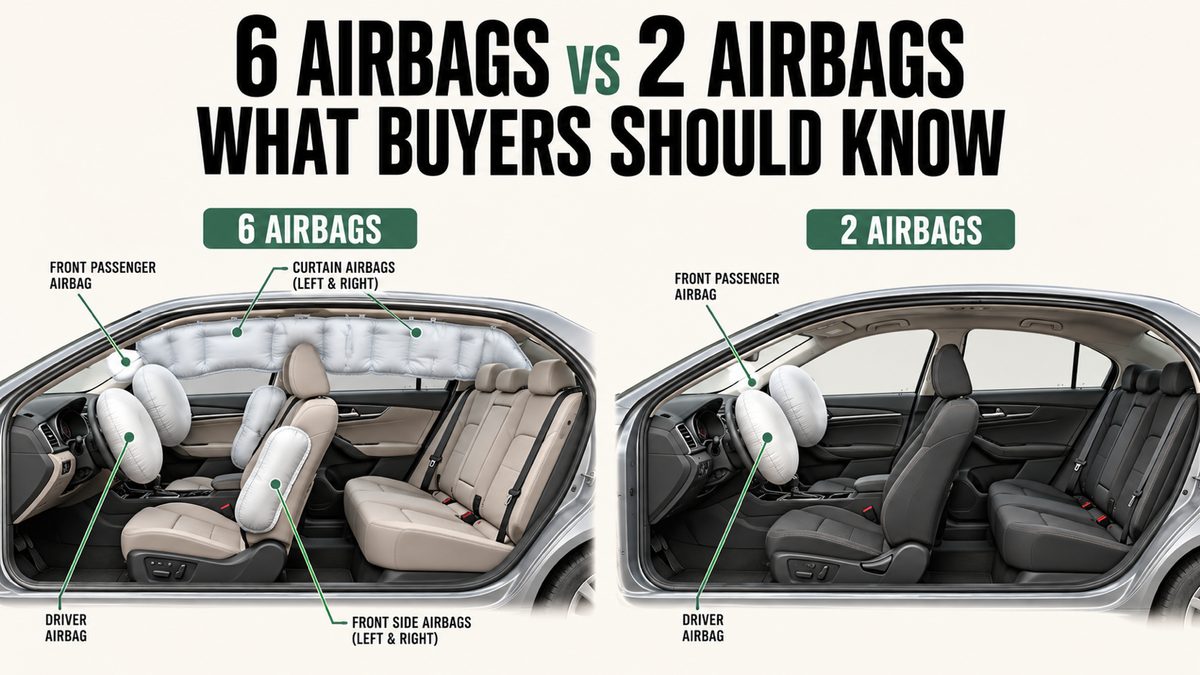
A typical two-airbag car provides frontal airbags for the driver and front passenger. A typical six-airbag arrangement adds front side airbags and side curtains, extending the types and areas of protection offered. Confirm the actual layout in the vehicle's manual because the count alone does not define every design.
More airbags do not turn a car into a guaranteed five-star vehicle. Structure, restraints, equipment and the relevant crash assessment all matter. Airbags supplement correctly worn seat belts; they are not a replacement for them.
Start with location rather than the number
Ask where each airbag is fitted and which occupants it is designed to help protect. Front airbags, seat-mounted side airbags and roof-area curtains have different roles. Six identical cushions placed anywhere would not describe a real protection system.
The common six-airbag description counts two frontal units, two front side units and two curtains. Curtain coverage and deployment conditions vary by vehicle. Do not assume that the words six airbags mean one separate airbag for every passenger.
Read the diagrams and warnings in the exact model's manual. A sales graphic may simplify the layout, while the manual explains locations, precautions and operation. Keep the information linked to the version you intend to buy.
What frontal airbags are intended to do
Frontal airbags provide supplementary protection in relevant frontal crashes. They work as part of a restraint arrangement rather than independently. NHTSA's consumer guidance emphasises using frontal and side airbags with seat belts.
The driver and passenger should sit properly and follow the vehicle's seating instructions. Do not put objects in an airbag's deployment path or place feet on the dashboard. An airbag needs space to operate, and incorrect positioning can create danger.
For a rear-facing child restraint, never place it in front of an active passenger frontal airbag. Use the vehicle and restraint instructions to choose an approved position. If an arrangement is unclear, obtain qualified fitting help rather than improvising.
What side and curtain protection adds
Side airbags and curtains address different contact areas from frontal airbags. Transport-agency guidance explains that curtain units are commonly located above the doors and that side protection supplements the front arrangement. The relevant manual determines the actual vehicle's coverage.
For a buyer, the practical benefit is broader protection capability rather than a simple three-times-safer calculation. Adding four units does not mean injury risk falls by an identical fraction in every crash.
Ask specifically about rear-seat curtain coverage if family members use those positions. Do not infer it from the total count. Also check seating and restraint arrangements rather than assuming the presence of curtains solves every rear-seat concern.
A simple equipment comparison
| Question | Typical two-airbag arrangement | Typical six-airbag arrangement |
|---|---|---|
| Driver frontal airbag | Included | Included |
| Front passenger frontal airbag | Included | Included |
| Front side airbags | Usually not part of this count | Commonly included |
| Curtain airbags | Usually not part of this count | Commonly included |
| Seat belts still necessary | Yes | Yes |
| Five-star rating guaranteed | No | No |
| Exact coverage confirmed by count alone | No | No |
The table describes a common layout, not a specification for every vehicle. Use the manufacturer's equipment record and manual to confirm the exact car.
Why the structure and restraint system still matter
A crash involves more than the cushion that inflates. The vehicle's structure, seating and restraints all form part of the assessed protection. An airbag count does not describe how these elements perform together.
This is why an applicable official crash result is more informative than the count alone. Read adult and child results separately and examine the fact-sheet notes. Do not create an unofficial safety ranking by awarding one point for each airbag.
Compare the exact model generation and equipment version. A result for an earlier car with two airbags may not describe an updated six-airbag version. Equally, an equipment update is not itself a new crash test unless an assessment has been published.
A real example of why the count is not the whole result
Global NCAP's December 2025 Celerio announcement described a previous two-airbag version receiving two stars for adults and one for children. It reported an improvement to three adult stars for the six-airbag version, while still noting concerns about the structure and child protection.
That example should not be treated as a controlled experiment isolating four added airbags from every other change. It shows that a six-airbag vehicle can still have a result below five stars and that the complete assessment matters.
Use the official entries and fact sheets for applicability. Do not generalise one model's improvement into a fixed star increase for every car. Different vehicles and assessment periods need their own evidence.
Deployment is not an all-or-nothing event
Do not expect every airbag to deploy in every collision. The system's design and the circumstances influence which units activate. A minor incident without deployment does not automatically prove failure, and visible damage alone cannot establish what should have happened.
If there is concern after a crash, have the manufacturer or a qualified investigator assess the vehicle. Keep the incident and repair records. An online photograph cannot determine the correct deployment decision for every event.
Do not test an airbag or attempt to open a module yourself. These are safety components requiring the correct professional procedures. Follow the manual and authorised workshop guidance for faults, repairs and disposal.
Seat belts remain essential in every seating position
Use the belt correctly on every journey and make sure passengers do the same. Do not treat an airbag as a reason to leave a rear passenger unrestrained. The protection arrangement depends on proper use, not merely equipment being present.
Check that each family seating position has a usable belt and that occupants can sit normally. Keep the belt path clear and do not use clips or other devices intended to defeat reminders. A silent warning is not a safely restrained passenger.
For children, use an appropriate compatible restraint according to the manufacturer's instructions. An adult holding a child or sharing a belt does not become safe because the vehicle has curtains. The child needs the correct arrangement for their size and the approved vehicle position.
Accessories can interfere with safety equipment
Before buying seat covers, check the manual's requirements for seat-mounted airbags. A cover that fits physically may not be suitable for the airbag system. Ask for manufacturer-approved guidance rather than relying on an accessory seller's general assurance.
Avoid placing objects over airbag covers or in deployment areas. Check dashboard mounts, ornaments and modifications against the vehicle's warnings. A decorative addition should not compromise a safety component.
If the vehicle displays an airbag or restraint warning, seek authorised diagnosis. Do not conceal the lamp, remove a connection or accept a reset without understanding the fault. A working warning system is part of recognising a problem.
Buying used requires extra checks
Inspect the repair history and ask about previous airbag deployment. Have a qualified workshop assess restraint systems and any relevant replacement work. A clean interior or intact-looking steering-wheel cover cannot establish correct repairs.
Match the original equipment specification to the vehicle identity and manufacturing period. Maruti Suzuki's May 2025 announcement standardised six airbags on several named models, illustrating why production timing can matter. Confirm the actual car rather than assuming all examples of a model have the latest equipment.
Do not rely on a seller's claim that airbags were never needed because the car is strong. Ask for documents and inspection findings. Avoid approving a purchase while a safety warning or unexplained repair remains unresolved.
How to weigh the upgrade in your budget
When comparing otherwise suitable cars, consider the additional protection equipment positively, but check the complete evidence. Look at official crash results, stability control, belts, child-restraint suitability and the car's condition.
Compare actual variants and payable prices. Six airbags may be standard on one model and tied to a more expensive package on another. Do not assume the lowest advertised price includes the equipment shown in the promotional image.
Keep essential maintenance, tyres and insurance affordable. Buying more equipment does not remove the need to operate and maintain the vehicle properly. Choose a car your household can keep in safe condition after delivery.
Frequently asked questions
Is a six-airbag car three times safer than a two-airbag car?
No such calculation follows from the count. Protection depends on the crash, equipment layout, structure, restraints and correct occupant use.
Do six airbags guarantee five stars?
No. Read the relevant official crash assessment and its applicability. Airbag numbers alone do not establish the rating.
Will all six airbags open in every crash?
Do not expect that. Deployment depends on the system and incident conditions. Concerns require qualified assessment, not assumptions based on visible damage.
Can I skip the seat belt if the car has airbags?
No. Airbags supplement correctly worn belts. All occupants need the appropriate restraints on every trip.
Are ordinary seat covers suitable for side airbags?
Do not assume so. Check the vehicle's requirements and approved guidance for the exact seat and airbag arrangement.
Does a used car have the same airbags as the latest brochure?
Not necessarily. Confirm its manufacturing period, original specification, repair history and present restraint-system condition.
Check the whole protection package
Ask for the exact airbag layout, applicable crash result and restraint information. Confirm the delivered or used vehicle's specification and investigate warnings properly. Choose additional protection with clear evidence, while keeping correct belts and child restraints central to every journey.