



Quick answer
Ask for the car's repair history, compare the documents with a daylight inspection and have an independent professional assess its structure and safety systems. Repainted panels, uneven gaps or replaced parts can justify closer checks, but one visual clue cannot establish the severity or cause of past damage.
A useful used car accident check in India combines records and the actual vehicle. A clean insurance claim history does not prove accident-free use, because some repairs may have been paid for privately. Equally, a cosmetic repaint does not automatically mean the car suffered structural damage.
Do not pay a deposit while serious repair questions remain unresolved. Ask the inspector to distinguish confirmed findings from concerns needing further diagnosis. If essential safety or structural condition cannot be established, consider another car.
Ask a clear question before the viewing
Ask whether the car has had collision repairs, structural work, airbag deployment, flood exposure or insurance claims. Request the answer in writing along with any repair invoices. A broad phrase such as company maintained does not answer those questions.
Ask what was repaired, when, where and why. The seller may not know every event before their ownership, especially if the car has changed hands. Keep that limit visible rather than treating an honest lack of knowledge as a clean history.
Request permission for an independent inspection before discussing a non-refundable booking amount. A seller's reluctance to allow reasonable checks is a reason to reconsider the transaction, even when the advertisement looks convincing.
Separate cosmetic work from structural repair
A scratched bumper and a repaired structural member raise different questions. Ask the technician to identify which components were affected and whether the repair can be assessed properly. The number of painted panels alone is not a severity scale.
Some panels can be replaced without establishing damage to the main structure. Conversely, a car with neat exterior paint can still require closer structural assessment. Avoid deciding that a vehicle is safe merely because the gaps look even in photographs.
Your decision should reflect the actual findings, repair evidence and intended use. A fixed discount for every repainted panel is not a substitute for understanding whether the work was cosmetic, substantial or still uncertain.
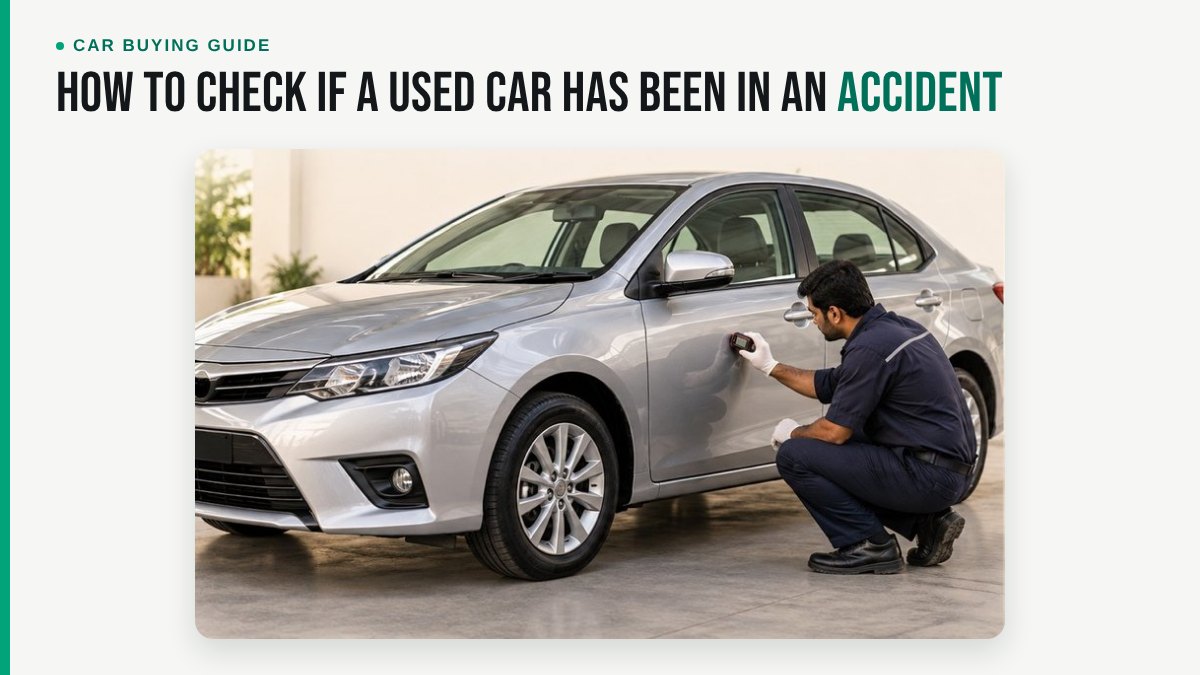
Inspect in daylight with a clean exterior
View the vehicle in natural light where possible. Heavy dirt, darkness and reflected showroom lighting can make small details harder to assess. Ask for enough space to walk around the car without standing in traffic.
Look along adjacent panels for differences in colour or finish. Check edges around seals and trim for overspray or roughness. These can suggest paint work, though age, polishing and original finish variation can also affect appearance.
Do not scrape paint, lift bonded seals or dismantle trim yourself. Ask the inspector to choose non-damaging methods and obtain the owner's permission for anything beyond a normal viewing. The assessment should not create new damage.
Use visible clues as inspection prompts
| Observation | What it may prompt | What it does not prove alone |
|---|---|---|
| Different paint finish | Check repainting and repair records | A severe collision |
| Uneven panel gaps | Inspect alignment and prior work | The exact cause or repair quality |
| Tool marks on fasteners | Ask about removed or replaced parts | Structural damage |
| New glass on one side | Check replacement reason and invoice | Airbag deployment |
| Warning lamp irregularity | Diagnose the relevant system | A complete account of past damage |
Photograph concerns with permission and show them to the professional. Avoid turning each clue into a separate accusation. Several findings and the repair records need to be considered together.
Do not accept the reverse argument either. The absence of these clues cannot certify that the car has never been repaired. Skilled cosmetic work may leave little obvious evidence during an ordinary viewing.
Have the structure assessed properly
Ask the inspecting workshop to examine accessible structural areas, seams, mounting points and underbody condition using suitable equipment. The exact inspection depends on the model and what can be accessed without dismantling.
Let the professional explain any signs of repair, corrosion, deformation or non-standard welding. Ask whether a specialist body inspection or measurement is needed. A visual pre-purchase report should state its access limits rather than promise certainty about hidden areas.
Never get beneath a car supported only by its emergency jack. If a seller cannot provide safe access for an underbody check, arrange an appropriate workshop visit. A phone photograph taken underneath is not equivalent to a proper inspection.
Check restraint systems through a qualified technician
Ask the technician to inspect relevant warning-lamp behaviour and use suitable diagnostic equipment for the car. A warning that stays on or behaves unexpectedly requires investigation. Do not assume a lamp going out proves every restraint component is present and functional.
Request records for any airbag or seat-belt pretensioner replacement. The repair should be evaluated against the correct manufacturer's procedures. Do not dismantle an airbag or probe its wiring yourself; these are safety systems requiring trained handling.
If evidence suggests bypassed or incomplete restraint repairs, do not treat a lower purchase price as a solution. Ask for a clear professional assessment before proceeding. An unresolved safety-system concern is different from a scratched trim panel.
Read invoices for the work actually completed
Match the registration or vehicle identification details and dates on the repair file. Distinguish an estimate from an invoice for completed work. An estimate containing several parts does not establish that all were replaced.
With owner consent, ask the issuing workshop to confirm the work and explain important entries. Use independently verified contact details where possible. A seller's forwarded message from an unknown number is not the same as direct workshop confirmation.
Look for photographs taken before and during repairs if legitimately available. They may clarify what happened, but check that they relate to this car. A small selection of repair images may still omit areas needing current inspection.
Understand insurance history limits
Ask the owner for available claim and repair documents through the insurer's authorised process. Access may require consent and the insurer may not provide every detail to a prospective buyer. Do not try to use another person's login credentials.
A claim can concern different kinds of loss, so ask what it covered. A windscreen claim and a major collision claim should not be treated as identical. Have the technician connect the documents to the car's current condition.
No recorded claim does not establish no accident. Repairs may have been paid privately or records may be incomplete. Keep this distinction clear when a seller uses a claim-free statement as the main evidence of an undamaged car.
Test drive only after basic safety checks
On a safe permitted route, note pulling, steering position, vibration, braking concerns and unusual noise. Let the technician assess possible causes. A car pulling to one side may need several checks; it does not identify a past accident by itself.
Do not perform emergency braking or high-speed manoeuvres to test a suspicious car. Stop if anything appears unsafe and return to workshop assessment. A pre-purchase drive should not expose occupants or other road users to unnecessary risk.
Ask about wheel alignment records and repeated tyre replacement where relevant. They may support further questions but do not replace structural inspection. A recent alignment printout alone cannot certify the entire vehicle's condition.
Distinguish flood damage from collision history
Check disclosed water exposure separately. A vehicle can have water-related damage without a collision, and a collision report does not answer that issue. Ask the workshop to assess relevant electrical, corrosion and interior findings.
Odour, new carpeting or a stain can prompt questions but is not conclusive proof. The owner may have replaced trim for another reason. Compare several findings with available repair records before deciding what remains uncertain.
Do not start or drive a car suspected of a current serious water-related fault simply to see whether it works. Let the technician decide safe diagnostic steps. Avoid buying on an unsupported promise that drying the cabin has resolved every issue.
Read the inspection programme terms
Manufacturer-backed used-car programmes can provide useful reports. True Value describes checks including history and vehicle condition, while Hyundai Promise describes its own inspection programme. Request the actual report for the car, not only a brochure describing the service.
Ask how the report defines repaired panels, structural concerns and uninspected areas. Check when it was completed and whether any repairs occurred afterwards. A report can only describe the assessment and evidence within its stated scope.
Read any warranty separately. It may not cover previously repaired bodywork, accident consequences or every safety component. Do not assume a mechanical warranty turns an uncertain structural history into a confirmed safe purchase.
Choose with the findings in front of you
Before paying, request a written inspection showing confirmed defects, unresolved concerns and any further checks required. Compare the repair history with the current condition. Ask for estimates where work is proposed, without assuming that every serious concern can be fixed economically.
If the report identifies substantial structural uncertainty or questionable restraint repairs, consider another vehicle. A cheaper purchase is not automatically suitable for a family budget when the essential safety position remains unclear.
Record the seller's disclosures and any agreed repairs in the sale paperwork. Keep your inspection and document copies securely. Clear records help you understand the car now and describe it honestly if you later sell it.
Frequently asked questions
Does repainting mean a car had a serious accident
No. Paint work can follow scratches, cosmetic damage or more substantial repairs. Ask why it was done and have the affected areas assessed. Panel count alone does not establish severity.
Can a clean insurance history prove accident free use
No. Some repairs may have been paid privately and records may be incomplete. Compare available insurance documents with service invoices and an independent inspection.
Is a diagnostic scan enough to check accident history
No. Diagnostics can provide useful information about accessible systems but cannot replace body and structural assessment. A clean scan is not a certificate that no collision occurred.
Should I reject every car with a replaced panel
Not automatically. Identify the component, reason and repair quality. A qualified inspector can help distinguish cosmetic work from concerns affecting structure or safety. Unresolved serious findings justify choosing another car.
What should I do if the seller refuses inspection
Do not pay an irreversible deposit on the assumption that checks can happen later. Explain the assessment you need and consider another vehicle if reasonable verification is not allowed.
Sources and checks
- True Value buyer and seller guidance for disclosed accident history, daylight inspection and document checks.
- True Value certification for programme inspection information.
- Hyundai Promise India for its used-car inspection programme.
This guide does not certify a specific vehicle or claim access to private insurance records. Model-specific inspection and repair assessment require a qualified professional.
Internal links for publication
Link to service-history verification, odometer checks and used-car warranty terms. Include the first-time buyer guide for readers arranging their first inspection.