



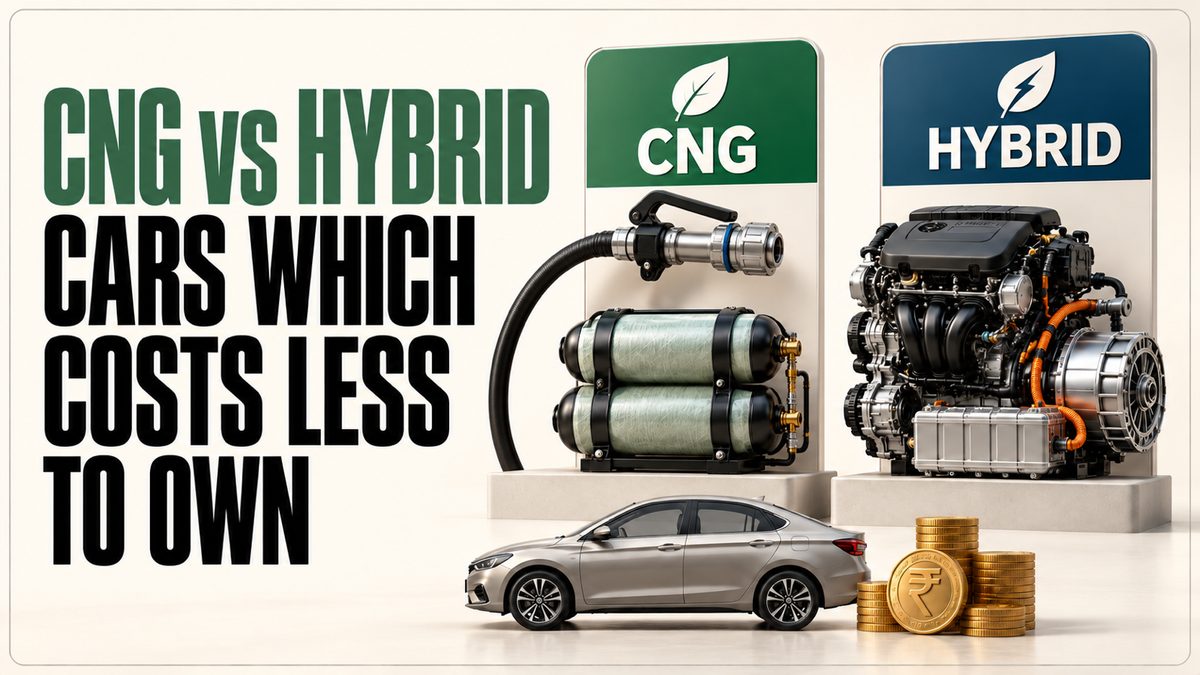
Quick answer
A CNG car can cost less to run per kilometre when local gas prices and actual fuel economy are favourable. A strong hybrid can be easier to live with when you want petrol-station convenience, automatic driving and no external charging. Neither is automatically cheaper to own: the purchase-price difference and your annual distance can outweigh a small fuel-cost advantage.
Compare two exact variants, not just two fuel labels. Include the on-road bill, fuel, scheduled maintenance, insurance and expected ownership period. Treat resale estimates and future repairs as uncertain. This article compares factory CNG cars with non-plug-in strong hybrids, not mild hybrids or battery-electric cars.
What are you actually buying
A factory CNG car has a fuel system designed to use compressed natural gas, usually alongside a petrol system. Its cylinders need appropriate space and maintenance. Refuelling requires a suitable CNG station. The packaging and driving behaviour vary by model, so the cylinder label alone says little about family practicality.
A non-plug-in strong hybrid combines a petrol engine with an electric drive system and a traction battery. It manages its energy during use without a home charging connection. It still consumes petrol. Electric-only operation happens under the system's permitted conditions rather than giving the driver an unrestricted electric-car range.
Toyota's Hyryder specification sheet illustrates why the distinction matters. It separately lists E-CNG, neoDrive and hybrid powertrains. Its published economy references use km/kg for CNG and km/l for petrol hybrid. The larger-looking number cannot be compared directly without considering the price and unit of each fuel.
Compare the practical differences first
| Question | Factory CNG | Non-plug-in strong hybrid |
|---|---|---|
| What fuel do you buy | CNG, with petrol use as applicable | Petrol |
| Do you need external charging | No | No |
| What should you check locally | CNG station access and queues | Suitable workshop and petrol access |
| What may affect luggage | Cylinder packaging | Battery and vehicle packaging |
| What extra records matter | Fuel-system service and cylinder documents | Hybrid maintenance and battery warranty |
| Can the badge establish total cost | No | No |
Use this table to identify the questions, not to assign every model the same result. Some CNG cars now offer automatic transmissions. Some strong hybrids have very different body sizes and purchase prices. Those differences can matter more than the fuel technology itself.
Calculate fuel cost with the correct units
For CNG, divide the local price per kilogram by the kilometres travelled per kilogram. For a petrol hybrid, divide the price per litre by kilometres per litre. Both calculations produce rupees per kilometre. Use a realistic consumption estimate for your journeys rather than treating a certification figure as guaranteed.
Here is an illustration using invented inputs, not current pump prices or measured car results. Suppose CNG costs ₹80/kg and the car returns 24 km/kg. Fuel cost is about ₹3.33/km. Suppose petrol costs ₹100/litre and the hybrid returns 22 km/litre. That works out to about ₹4.55/km.
Under those assumptions, the CNG car uses about ₹1.21 less fuel per kilometre. At 12,000 km a year, that is roughly ₹14,545 in annual fuel spending. The result changes if fuel prices, consumption or petrol use in the CNG car changes. Keep the calculation editable rather than presenting it as a permanent saving.
Put purchase price into the same calculation
Ask for itemised quotations for the two exact cars. Separate registration, insurance, accessories and any dealer packages. If one quotation includes a different insurance policy or optional equipment, the difference is not entirely the cost of the powertrain.
For another illustration, suppose the hybrid costs ₹2 lakh more on road than the CNG car. Using the fuel assumptions above, it is also dearer to fuel. There is therefore no fuel-only payback for choosing that hybrid over that CNG car in this example. You may still prefer its driving behaviour, seating or refuelling convenience.
Now change the comparison. If your chosen CNG automatic costs more than a lower-trim petrol hybrid after actual offers, the result may be different. Do not reuse a price gap from a different pair of vehicles. A useful ownership calculation starts with cars you would genuinely consider buying.
Test low running and high running separately
At low annual distance, fuel savings accumulate slowly. A household driving 5,000 km a year may find that a smaller purchase bill matters more than a modest difference in rupees per kilometre. Do not stretch the budget solely because a technology is advertised as economical.
At high annual distance, small operating differences become more significant. But high running also makes station access, workshop availability and downtime more important. A cheaper fuel bill is less helpful if refuelling requires a long detour several times a week.
Use at least two distance cases: what you drove last year and a cautious estimate of the coming year. If a change of job could reduce your commute, include that possibility. A purchase meant to last several years should not depend entirely on one unusually busy month.
CNG station convenience has a real value
Visit the stations you expect to use at your normal travel time. Check the route, likely queues and whether another station is available if the first is inconvenient. A station near home on a map may be difficult to reach from your actual direction of travel.
Record the extra kilometres and time involved. If a refill adds a regular detour, include the fuel used for it. Keep time as a separate personal consideration rather than assigning an invented rupee value to everyone. A driver with a fixed school run may view the same delay differently from someone with flexible hours.
A strong hybrid uses petrol-station infrastructure and does not need an external charger. That can make ownership simpler for someone without convenient CNG access. The benefit is practical; it does not by itself prove lower total spending.
Compare luggage and passenger comfort with the correct versions
CNG cylinder installations can affect the luggage area. Modern twin-cylinder layouts may preserve more usable room, but the actual opening and floor still need inspection. Take the suitcases, shopping bags or pushchair your family uses rather than judging from a showroom photograph.
Strong hybrid packaging can also differ from the petrol version of the same model. Do not assume the advertised boot figure or spare-wheel arrangement is identical across powertrains. Ask for the specification tied to the exact quotation and try your normal load.
Keep all required seats available during the demonstration. If the family usually travels with five people, a luggage test with a folded rear seat does not answer the question. Include parking dimensions and entry comfort before deciding that one fuel system suits you better.
Maintenance and warranty need written evidence
Ask each workshop for the official service schedule and a current estimate for the planned ownership distance. Check what the estimate includes, which items are routine and which are condition-dependent. A low advertised service package may not include every relevant item.
For CNG, ask about fuel-system maintenance and the documents required for the installed cylinders. For a strong hybrid, distinguish the traction-battery warranty from the general vehicle warranty and the ordinary auxiliary battery. Toyota's Indian warranty page, for example, lists hybrid HV battery cover of eight years or 1,60,000 km subject to its terms.
A warranty period is not a battery replacement schedule. Nor does it mean every fault, accident or age-related concern is covered. Read the terms for your model and purchase date. Avoid adding an unverified full battery replacement bill to every hybrid ownership calculation as if it were certain.
A sensible five-year comparison
Create one sheet with the purchase amount and five years of expected fuel spending. Add scheduled maintenance and insurance estimates on the same basis. Keep finance costs separate unless both quotations use the same loan amount and tenure. This makes the source of any difference easier to understand.
Use ranges for uncertain items. Resale can change with vehicle condition, local demand and the future market. A dealer's verbal future-value estimate is not a guaranteed payment. Similarly, allow for repairs without pretending that every owner will face the same failure.
Then add a short non-price list: refuelling access, automatic comfort, luggage, family seating and workshop reach. You do not have to choose the lowest calculated amount if another car solves an important daily problem. You should simply know what you are paying for.
Frequently asked questions
Is CNG always cheaper than a strong hybrid
No. The result depends on the exact purchase prices, local fuel rates, actual consumption, annual distance and maintenance. Compare the whole ownership period rather than one mileage claim.
Does a strong hybrid need home charging
A non-plug-in strong hybrid does not need an external charger. Do not confuse it with a plug-in hybrid or a battery-electric vehicle.
Can I compare km/kg directly with km/litre
No. Convert both to rupees per kilometre using the correct local fuel price. The units represent different quantities of fuel.
Is the hybrid battery replaced when its warranty ends
Not automatically. Warranty expiry does not establish a replacement date. Follow the manufacturer's inspection and diagnostic advice if a problem appears.
What if I only drive on weekends
Use your actual low annual distance. The purchase-price difference and convenience may matter more than fuel savings that take many years to accumulate.
Compare two real quotations
Choose one CNG car and one strong hybrid that both fit your family. Collect matching on-road quotations, check the workshops and stations, and calculate fuel cost using cautious inputs. Make the decision with the full bill and daily routine visible together.