



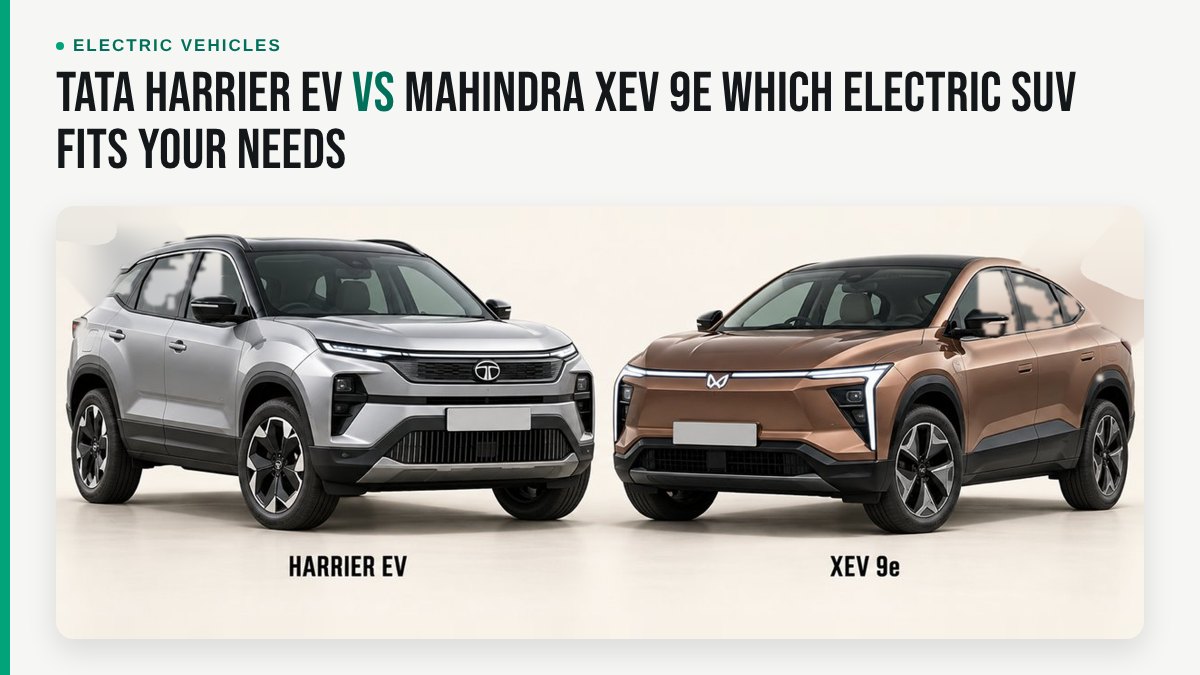
Quick answer
Shortlist the Tata Harrier EV if you need to assess its available dual-motor QWD configuration or prefer its cabin and luggage layout. Shortlist the Mahindra XEV 9e if its five-seat coupe-style layout and rear-wheel-drive specification suit you. Both need a realistic home-charging and long-trip plan before purchase.
Do not decide from the largest certified range or number of screens alone. Compare the exact battery and equipment grade within budget, include charger installation in the quotation and inspect both with your family. This is not a first-hand range test.
Compare battery and drivetrain together
Tata's manufacturer material identifies 65 kWh and 75 kWh battery choices, with rear-wheel-drive and an available 75 kWh QWD arrangement. Mahindra's current FAQ lists 59 kWh and 79 kWh choices for the XEV 9e and states that it is rear-wheel drive only.
| Requirement | Harrier EV to check | XEV 9e to check |
|---|---|---|
| Lower battery entry point | 65 kWh version | 59 kWh version |
| Larger battery option | 75 kWh version | 79 kWh version |
| Additional driven axle | Applicable QWD version | Not the RWD XEV 9e |
| Family seating | Confirm approved five-seat layout | Five-seat layout |
| Equipment comparison | Exact battery and grade | Exact battery and pack |
Nominal battery capacity is not the same as distance guaranteed on a journey. Vehicle efficiency, speed, load, weather and usable operating window all matter. A difference in kWh does not translate directly into the same percentage difference in road range.
Start with your charging location
Before paying a booking amount, identify where the SUV will charge on an ordinary night. Check your allocated parking place, cable route and access to the electrical supply. In an apartment, discuss installation permission and billing with the relevant management team.
Ask the manufacturer's installer to assess the site. The quotation should identify the charger, installation scope and any additional electrical work. Do not assume a charger included in a sales offer means every cable run, supply upgrade or civil alteration is included.
If you cannot charge at home or work, test the public-charging routine honestly. Consider queues, detours, opening hours and failure alternatives. A large battery can reduce charging frequency, but it does not remove the need for a dependable place to replenish energy.
AC charging and DC fast charging solve different needs
Home AC charging is usually planned around the time the vehicle is parked. Public DC charging is more relevant to some long journeys or owners without dependable AC access. Compare each vehicle's actual supported equipment rather than a station's advertised maximum alone.
A high-power charger does not supply its full nameplate output continuously to every car. Vehicle limits, battery temperature, state of charge and shared station capacity can change the session. A published short charging time applies to a defined window and conditions.
Mahindra quotes a 20 to 80 percent fast-charging interval for the XEV 9e. Do not rewrite that as a full-charge time. For both SUVs, ask which charger power and conditions support the claim, then plan additional time for arrival, connection and a possible queue.
Certified range is a reference rather than a route promise
Mahindra's current FAQ lists certified XEV 9e ranges of 522 km for 59 kWh and 656 km for 79 kWh. It separately qualifies its internal real-use estimates by test conditions. Those distinctions should remain visible when comparing the cars.
For the Harrier EV, use the current battery-specific manufacturer range and its stated test basis. Do not mix a certified result for one version with an owner's highway journey in another. Comparing two headline distances without their conditions can produce a false impression.
List your longest regular journey and dependable stops along it. Plan a reserve rather than targeting arrival at zero charge. Diversions, a closed charger or unexpected traffic can matter more to a family trip than a small numerical difference in certified range.
An energy cost example should show its assumptions
Assume a vehicle uses 20 kWh per 100 km and billed electricity costs ₹10 per kWh. Ignoring charging losses for this first calculation, energy costs ₹200 per 100 km, or ₹2 per kilometre. These are illustrative inputs, not measured consumption or a current tariff for either SUV.
Charging losses can make billed energy higher than energy used by the vehicle. Public charging may also have a different tariff or additional charges. Compare the billable session cost rather than assuming every kilometre will be supplied at a home electricity rate.
Add insurance, finance, maintenance and charger costs to the ownership estimate. A low assumed energy cost is not the complete cost of the SUV. Keep resale uncertain rather than using a guaranteed future offer to justify a budget stretch.
Decide whether QWD has a real use
The Harrier EV's available QWD version is relevant when you specifically want to assess a second driven axle. Compare its price, equipment and energy implications against the rear-wheel-drive version you would otherwise choose. Do not assume every Harrier EV has the same drivetrain.
Explain the actual surfaces and access needs to the dealer. Ordinary paved commuting does not automatically require additional driven wheels. Equally, a difficult regular route should not be dismissed solely because a lower version is cheaper.
Tyres, ground conditions and driver judgement still matter. Additional traction does not remove braking limits or make floodwater safe. Read the owner's instructions and obtain suitable familiarisation rather than testing unfamiliar terrain with the family aboard.
Cabin shape deserves an ordinary family inspection
The XEV 9e has a coupe-style body, so check rear entry and head clearance with your passengers. Do not decide only from the roofline photograph. Seat position, door opening and passenger height determine whether the arrangement works for your household.
Inspect the Harrier EV in the same way. Set the front seats correctly and ask rear passengers to sit naturally. Check foot space, the middle position if used and belt access with your child seat installed according to the approved method.
Bring normal luggage and try the openings. Inspect storage with essential charging and repair equipment present. A published volume cannot describe every bulky pram or suitcase, and a folded-seat demonstration does not answer a journey with all seats occupied.
Screens should be tested rather than counted
Operate common functions while parked. Check temperature adjustment, demisting, phone connection and navigation input. Make sure the usual driver understands the information without needing to study several displays during a journey.
Ask which connected functions require a network, compatible phone or later subscription. Confirm what happens when connectivity is unavailable and retain a physical access plan where the manufacturer recommends it. A digital key demonstration does not remove every phone-related limitation.
Compare useful equipment at the same budget. Camera views, comfortable seats and controls you can use easily can matter more than the largest audio or display specification. Confirm grade-specific availability on the written order.
Safety evidence must stay separate from driver assistance
Check the applicable Bharat NCAP records for the exact models and production coverage. Keep adult and child results separate. Do not turn a high crash score into a guarantee about every possible collision or use a related vehicle's result without confirmation.
ADAS and parking automation also need variant-level verification. Ask what is fitted and read its operating limits. Arrange a safe explanation of controls rather than attempting a risky demonstration of emergency intervention on a public road.
Electric acceleration can make a brief test feel dramatic. Assess gentle response and braking control as well. The regular driver should be comfortable moving slowly around pedestrians and parking areas, not only with the vehicle's ability to accelerate quickly.
Battery warranty needs the actual contract
Obtain the high-voltage battery warranty and vehicle warranty separately. Check eligible owners, registration conditions, time and distance limits, exclusions and the definition of a covered fault. Do not interpret a headline lifetime statement as identical protection for every owner forever.
If you may sell the SUV, ask what coverage passes to a subsequent owner. Check the required maintenance and records. Battery condition, a warranty claim and ordinary changes in capacity are not automatically the same issue.
Locate the workshop that can support the vehicle and ask how roadside assistance handles an immobilised EV. Confirm the correct recovery procedure from the manufacturer. Do not assume any nearby garage or towing method is suitable for high-voltage work.
Compare complete quotations rather than entry prices
| Quotation item | What to record |
|---|---|
| Vehicle | Battery, pack, drivetrain and model year |
| Charger | Hardware and installation scope |
| Registration | Actual location and applicable charges |
| Insurance | Matching cover, value and deductibles |
| Finance | Battery and vehicle obligations in full |
| Extras | Accessories and subscriptions separately |
If a battery-financing or chassis-only offer is quoted, compare all associated payments and terms with a full-battery purchase. Do not treat a lower initial figure as the complete vehicle cost. Include interest and required charges over the chosen period.
Get the delivery date and booking conditions in writing. A lower quote for a different battery or older stock is a separate offer, not necessarily a discount on the vehicle you originally compared.
Questions about Harrier EV and XEV 9e
Does every Harrier EV have QWD
No. The manufacturer distinguishes rear-wheel-drive and QWD configurations. Confirm the exact battery, drivetrain and equipment grade before ordering.
Is the XEV 9e a seven seater
No. Mahindra identifies it as a five-seat SUV coupe. Do not confuse it with another electric model in the manufacturer's range.
Can I rely on certified range for every highway trip
No. Use it as reference information and plan your route with reserve and charging alternatives. Actual conditions affect energy use.
Is a 20 minute charging claim a full charge
Not when the claim refers to 20 to 80 percent. Check the stated window, charger power and conditions before planning a stop.
Which should I buy without home charging
Neither should be booked until you have assessed dependable charging access. Try the actual public routine and its costs rather than assuming a bigger battery solves access problems.
Confirm charging before choosing the battery
Arrange the installation assessment, test both SUVs with your family and compare exact battery and drivetrain quotes. Plan a regular long-distance route with backup charging stops. Choose after the charging routine and full ownership budget work, not only the showroom demonstration.
Related reading
- On-road price calculation explained
- Annual car ownership cost breakdown
- New car discount negotiation tips