



Quick answer
There is no fixed discount every new-car buyer should expect. Negotiate using current written offers for the exact variant and compare the final payable amount with matching products. Separate the cash discount, exchange value, conditional bonuses, insurance and accessories before deciding whether an offer is genuinely better.
Start by asking two or three authorised dealers for itemised quotes. A number claimed by another buyer is not a guaranteed target for your car, city or delivery date. Your aim is a suitable vehicle at a clear total price, not the largest discount printed on a sheet.
Decide what you are buying before discussing discounts
Fix the model, variant, engine, transmission and acceptable colours. Identify the safety and seating requirements you will not compromise. Otherwise, an attractive offer can move you into a different car that does not meet the original need.
Set an on-road budget and keep a separate allowance for ownership costs. Do not expand the budget merely because a higher variant has a larger advertised saving. A discount reduces a price; it does not make an unnecessary upgrade free.
Get a written baseline quote
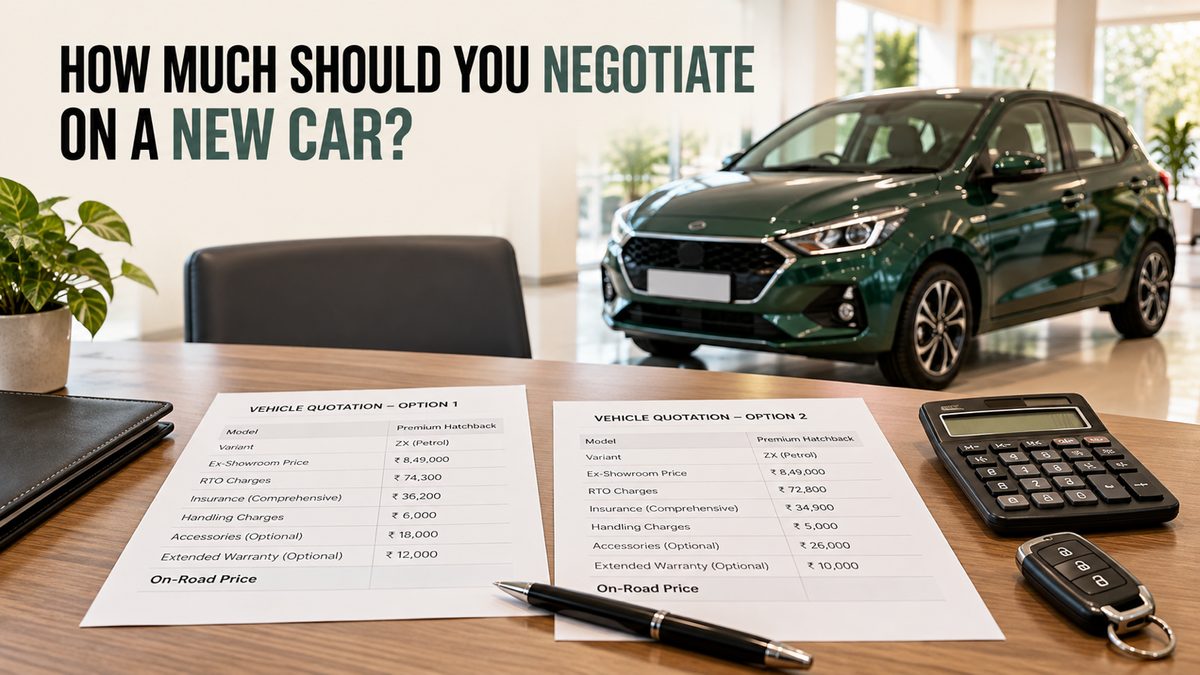
Ask for the current vehicle price, registration calculation, insurance details and every added product. Have the dealer identify what is compulsory and what is optional, with the basis for any disputed charge. An unexplained total is hard to negotiate sensibly.
The quote should name the exact variant and registration location. Record the date, validity period and expected delivery arrangement. A price for a different transmission or a vehicle unavailable on your timetable is not a matching comparison.
Ask whether the amount applies at booking, invoicing or delivery. Hyundai's online booking terms allow changes to prices and specifications and treat commercial terms as part of the customer-dealer agreement. Do not assume a booking payment freezes every later amount.
Separate the different kinds of offer
A cash discount reduces the price without requiring you to value an accessory at its advertised retail amount. An exchange bonus may depend on exchanging an eligible vehicle. Corporate or other eligibility benefits can require specific documents.
NEXA's official offer information states that corporate benefits can be limited to selected organisations and that exchange offers have outlet-related conditions. The useful lesson is to verify eligibility, not to add every maximum benefit shown in an advertisement.
Ask whether the benefits can be combined. Two attractive figures may be alternatives rather than additions. Obtain the final combination for your transaction in writing so that a headline offer is not mistaken for an unconditional reduction.
| Quote component | What to ask | How to compare it |
|---|---|---|
| Cash discount | Is it unconditional for this car | Deduct from matching vehicle total |
| Exchange value | What is paid for my old car | Compare separately with other bids |
| Exchange bonus | What conditions must I satisfy | Add only when eligible |
| Corporate benefit | Is my employer eligible | Verify documents and timing |
| Accessories | Which exact products are included | Use your value for items you need |
| Insurance | What cover and insured value apply | Compare matching policies |
| Finance-linked offer | What loan conditions apply | Compare full borrowing cost |
Compare the final bill rather than the discount headline
Consider an illustrative comparison, not a current dealer offer. Dealer A has a matching pre-discount total of ₹10,00,000 and gives ₹30,000 cash off. The payable amount is ₹9,70,000 before any separately agreed exchange transaction.
Dealer B has a total of ₹10,30,000 because it includes an extra ₹30,000 package, then advertises ₹50,000 off. The amount payable is ₹9,80,000. Despite the larger discount, B is ₹10,000 more expensive if you do not value that extra package.
Remove products you do not need and compare again. If B removes the package and keeps the same discount, the result changes. The written payable total after all agreed changes is what matters, not the first number used to attract attention.
Keep the old car valuation independent
Request a separate valuation for the car you plan to exchange. Compare it with other credible purchase offers, allowing for convenience, outstanding finance and transfer arrangements. Do not let the dealer hide a low old-car valuation behind a large new-car bonus.
For example, an additional ₹15,000 exchange bonus does not help if the same transaction values your old car ₹25,000 lower than a credible alternative. Compare the net amount needed to change cars, while keeping the records separate.
Negotiate insurance using the actual policy
Ask for the insurer, insured declared value, deductibles, cover periods and selected add-ons. A reduced premium is useful only if it still provides the protection you intend to buy. Do not compare a stripped-down policy with a broader one as if they were identical.
IRDAI's consumer guidance recommends comparing insurer quotes and checking coverage, value and deductibles. For a new private car, distinguish the third-party period from the own-damage period. A longer liability period does not mean every protection has the same duration.
Ask the dealer whether it can match a suitable outside quote. If a lender has requirements, check them too. Keep the eventual policy documents rather than relying on the insurance amount shown in the vehicle quotation as proof of cover.
Do not let finance hide a weaker purchase price
A dealer may offer a vehicle benefit linked to its finance arrangement. Request the loan terms before valuing that benefit. Processing charges, tenure and other conditions can affect whether the package saves money overall.
Compare the same loan amount and repayment period where possible. A smaller EMI can come from borrowing for longer, not from a lower rate or cheaper purchase. Ask the lender for the full repayment schedule and all applicable charges.
Keep a cash-price comparison even if you will borrow. That separates the car transaction from the credit decision. Do not accept an unsuitable loan merely to preserve a small discount that may be outweighed by borrowing costs.
Older stock needs inspection as well as a price discussion
A dealer may be more willing to negotiate on a vehicle held in stock for longer. That does not make every older car a bad purchase or a bargain. Ask for the manufacturing details and the identity of the actual vehicle offered.
Check condition, storage history where available and whether the car matches the specification you expect. Obtain an inspection before committing to the identified vehicle under the agreed process. A saving should not compensate for unresolved damage or missing promised equipment.
Consider resale expectations and how long you plan to keep the car. A previous manufacturing year may matter differently to a short-term owner and a household keeping it for many years. There is no universal discount amount that settles that trade-off.
Timing can help but does not guarantee a better deal
Month-end, festive and year-end offers are worth checking. They are not rules that force every dealer to reduce every model. Demand, stock and the manufacturer's current schemes can make an urgent popular variant less negotiable.
Waiting also has costs. The available colour or trim may change, your current vehicle may need repairs, or a promotion may expire. Compare the known cost of buying now with the uncertain benefit of waiting instead of assuming the next calendar date guarantees savings.
Read whether an offer depends on booking, invoicing or delivery within a stated period. A promise made before an offer expires needs written confirmation of how eligibility will be handled. Do not assume a delayed allocation automatically preserves the original benefit.
Make a clear counteroffer
Use the written comparison to make a specific request. You could ask the dealer to match another authorised dealer's final price for the same vehicle and cover. State which optional products you want removed or retained.
Keep the discussion polite and factual. Do not invent another dealer's quotation, alter a document or misrepresent corporate eligibility. A clear comparison is enough to show why the current total does not work for you.
If the dealer cannot reduce cash price, consider whether a genuinely useful product has value to you. Confirm the exact item and its conditions. Decline extras you do not need rather than treating every free label as a reason to close the purchase.
Record the agreement before making a larger payment
The final order should identify the car, agreed price and discounts, chosen products, payment schedule and relevant delivery conditions. Record how booking money will be adjusted. Retain the cancellation terms rather than relying on a general verbal assurance.
Make payments through the authorised process and keep receipts. Check the recipient details independently where necessary. Manufacturer warnings about fraudulent promotions are a reason to verify an offer through an official dealer, especially when a payment request arrives through an unfamiliar message.
At delivery, reconcile the final invoice with the agreement. A last-minute product addition or missing discount needs explanation before it disappears into the balance payment. Keep your quotation and invoices together for future reference.
Questions about negotiating a car purchase
Should I ask for a fixed percentage discount
You can make an offer, but no percentage is guaranteed across models. Use current matching quotes and the selected vehicle's conditions. A large percentage target without market evidence may not be realistic or useful.
Is cash payment always cheaper than a car loan
Not necessarily in the quoted vehicle offer, because some benefits may be finance-linked. Compare the full purchase and borrowing costs. Do not confuse paying without a loan with making unrecorded cash payments or avoiding required documentation.
Are free accessories as good as a cash discount
Only if you need them and value them at the amount you would willingly pay. An inflated accessory price does not establish real savings. Ask for product details and compare the total without the bundle.
Can I negotiate on road tax
Ask for an accurate calculation and challenge errors, but do not expect a dealer to bargain away a statutory liability. Separate government amounts from dealer products so that the discussion concerns the correct item.
Should I book immediately when an offer expires today
Only after checking the car, written terms and your budget. A deadline does not remove the need for a proper decision. If essential information is missing, ask for it before paying rather than relying on urgency as proof of value.
Ask for a cleaner final offer
Send the dealer your exact vehicle requirement and request a revised itemised quote with all eligible benefits and no unwanted products. Compare at least one matching alternative, then choose based on the payable amount, vehicle condition and written terms rather than the biggest discount claim.