



Quick answer
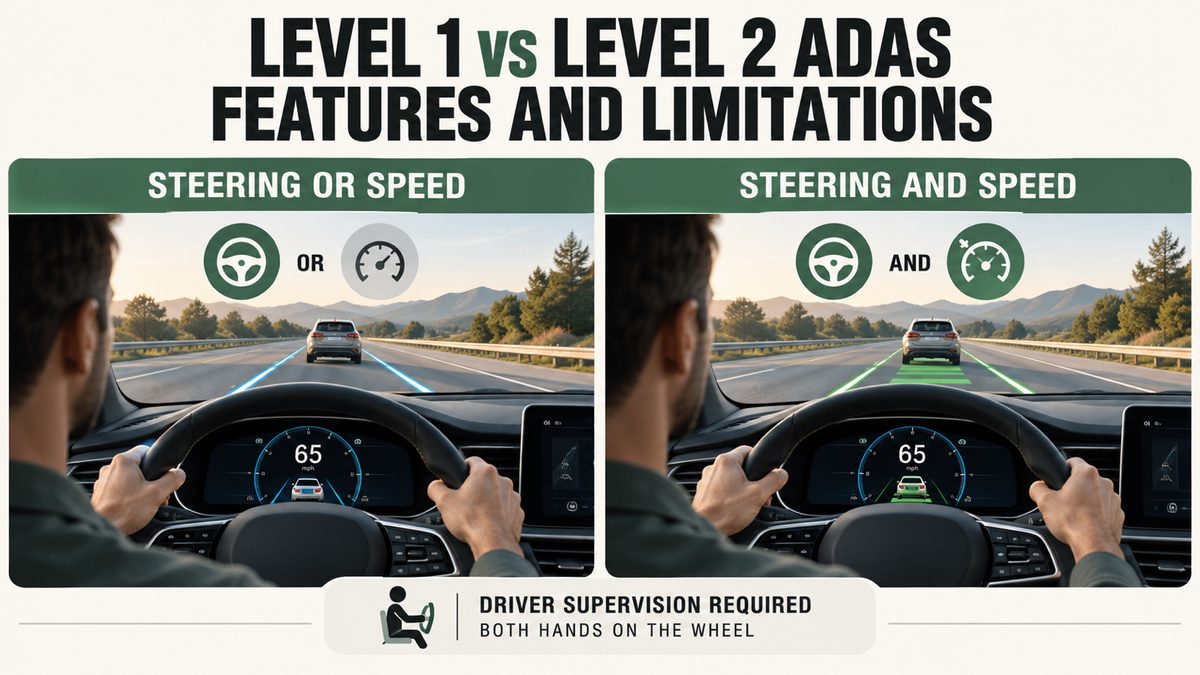
Level 1 driving assistance supports sustained steering or speed control. Level 2 can support steering and speed control together under its specified conditions. In both cases, the driver must supervise, remain attentive and intervene when needed. Neither level means the car can be left to drive itself.
The level describes a type of driving support, not a safety score or a count of features. Compare the actual functions, operating conditions and driver instructions in the exact vehicle's manual. Do not assume that two cars carrying the same label behave identically.
What the levels actually describe
SAE's driving-automation classification distinguishes Level 1 support for steering or speed from Level 2 support for steering and speed. It keeps continuous driver supervision necessary at both levels. That central distinction is more useful than a long list of promotional names.
Think of steering support as assistance with the vehicle's path and speed support as assistance with acceleration or braking over time. Whether either function is available depends on the system and conditions. A car can have several warning functions without providing both forms of sustained control together.
Use the classification to ask better questions, not to avoid reading the manual. The level alone does not tell you the minimum speed, permitted road type, detection limits or how the driver must respond to alerts.
Warnings and brief interventions are different from sustained control
A collision warning alerts the driver to a possible risk. Automatic emergency braking can intervene in specified circumstances. These functions should not be confused with a system that continually manages speed and steering during ordinary travel.
Likewise, a lane-departure alert can warn when the car approaches a marking, while a lane-related steering function may provide a different kind of intervention. Marketing names vary, so ask the manufacturer to explain what the particular function does.
A large feature count does not establish a higher automation level. Ten alerts and interventions are not automatically equivalent to a combination of sustained speed and steering assistance. Compare capability rather than counting every item in a brochure as one equal unit.
A plain comparison
| Question | Level 1 | Level 2 |
|---|---|---|
| Sustained support | Steering or speed control | Steering and speed control together |
| Driver watches the road | Yes | Yes |
| Driver handles situations outside capability | Yes | Yes |
| Driver can stop supervising | No | No |
| Exact functions fixed by level alone | No | No |
| Same performance in every car | Not established | Not established |
This table explains the classification, not a promise about every branded package. A manufacturer's feature chart and manual remain necessary to understand the car you are buying.
What adaptive cruise control usually needs you to understand
Ask how the system manages the selected speed and following distance, what it detects and when it becomes unavailable. Confirm the operating range and whether stopping and restarting in traffic are supported in your particular version.
Do not confuse adaptive cruise control with ordinary cruise control. Conventional cruise does not offer the same following-distance function. A similar steering-wheel button or familiar name can otherwise cause a serious misunderstanding.
Keep an appropriate gap and be ready to brake. Do not assume the system will manage every cut-in, stationary obstacle, junction or unusual road situation. Learn the manual's exclusions before relying on the function during a journey.
What steering assistance does not promise
Lane assistance may depend on visible markings and other conditions described by the manufacturer. Honda's global SENSING explanation describes lane functions using pavement markings and also states that recognition and control have limits. The Indian model's manual determines its actual equipment and operation.
Roadworks, unclear boundaries and unusual layouts deserve direct driver judgement. Do not assume the system understands a temporary lane simply because it worked on a well-marked road earlier. The driver must maintain a safe path.
Follow the vehicle's hand-position and supervision instructions. A steering function should not encourage you to photograph the dashboard, turn towards rear passengers or experiment with how long the car continues without input.
Level 2 is not a permission to stop driving
NHTSA's consumer explanation also keeps the human responsible when using driver-assistance technologies at these levels. It distinguishes such assistance from systems intended to perform driving without the same continuous human supervision. This explanation of capability is not a statement of Indian legal approval.
For an Indian buyer, the practical rule is straightforward: remain the driver. Watch the surroundings, control the car when required and use the system only as instructed. A promotional phrase suggesting autonomous travel does not override that responsibility.
Do not use a phone, sleep or move out of a normal driving position while assistance is active. A warning that asks for attention is not the moment to begin working out what is happening. Continuous supervision means being engaged before the alert arrives.
The same level can hide different packages
Two Level 2 vehicles may differ in sensors, software, function availability and operating conditions. One may include functions or traffic support that another does not. The label alone cannot rank their reliability or usefulness on your route.
India-specific examples also show different marketing approaches. Kia's Sonet information describes Level 1 ADAS, while Hyundai's current Venue safety information describes Level 2 SmartSense. Compare their current feature charts and exact variants rather than assuming a fixed list follows from either label.
Do not generalise from an overseas review of a similar model. Equipment can differ by market, year and transmission. Ask for the manual and brochure applicable to the Indian version on your quotation.
Sensors do not remove operating limits
Cameras and other sensors supply information, but detection can be limited by the conditions and system design. Ask what the manual says about visibility, weather, dirt, road markings and objects that may not be recognised.
Keep sensor areas maintained as instructed and avoid unauthorised accessories or modifications around them. If a warning appears after repair work, seek proper assessment. Do not assume a clean-looking windscreen proves that all relevant checks have been completed.
Treat repeated unusual behaviour as a reason to stop relying on the function and contact authorised support. Record the circumstances safely after stopping. A short video taken by the driver while moving is not worth the distraction it creates.
How to assess a car during a test drive
First check the normal driving position, visibility, brakes, steering and comfort. These remain important whenever assistance is off or unavailable. A feature demonstration should not distract you from whether the car suits ordinary daily driving.
Ask the representative to explain controls while stationary. Learn how to recognise active, standby and unavailable states, and how to cancel the functions normally. Ask where those instructions appear in the manual so you can read them later.
On the road, follow the representative's approved process and remain in control. Do not create an emergency-braking test, deliberately drift towards another vehicle or remove your hands to prove a claim. A safe explanation is more useful than a risky demonstration.
Questions to ask before paying extra
Ask which functions are standard on the exact trim and gearbox. Confirm whether the quoted car has adaptive or conventional cruise, what lane function is included and whether any connected-service subscription is involved.
Ask about the cost and procedure for relevant sensor, windscreen or body repairs. Confirm the manufacturer's instructions for checks after an impact. The purchase price is not the only ownership cost associated with additional equipment.
Then compare the package with your actual use. A driver who rarely travels on suitable roads may value it differently from someone with regular compatible journeys. Do not stretch the budget so far that essential insurance or maintenance becomes difficult.
Assistance and crash protection should be checked separately
An automation level is not an NCAP result. Review the official crash assessment and its applicability where available. Keep adult and child protection results distinct from the assistance feature list.
Check seat belts, child-restraint compatibility and the equipment you will use every day. The presence of assistance does not make an unsuitable restraint arrangement acceptable. Safe use of the whole car matters more than one label.
For used cars, verify original equipment and repair history. Arrange a qualified inspection if driver-assistance components may have been damaged or altered. A seller's claim that it is Level 2 is not a diagnostic report.
Frequently asked questions
Does Level 2 mean self-driving?
No. It still requires continuous driver supervision and intervention when needed. Use it as driver support under the manufacturer's conditions.
Can Level 1 include emergency braking?
A package can include warning or emergency-intervention functions, but feature names alone do not determine the sustained-control classification. Read the particular package description.
Do more ADAS features mean a higher level?
Not necessarily. The level concerns the driving task supported, not the number of named functions. Compare what the equipment actually does.
Is every Level 2 system equally capable?
No such conclusion follows from the label. Operating conditions, functions and equipment vary between vehicles and versions.
Can I look away while the car steers?
No. Remain attentive and follow the supervision instructions. A steering function does not remove the need to observe and control the journey.
Does the level tell me the crash-test score?
No. Driving assistance and crash-protection assessments are different information. Check the relevant official rating separately.
Read the functions before choosing the label
Ask for the exact feature chart and manual, learn the controls while parked and take a normal supervised test drive. Choose the package for its documented functions and your needs, while remaining responsible for driving.