



Quick answer
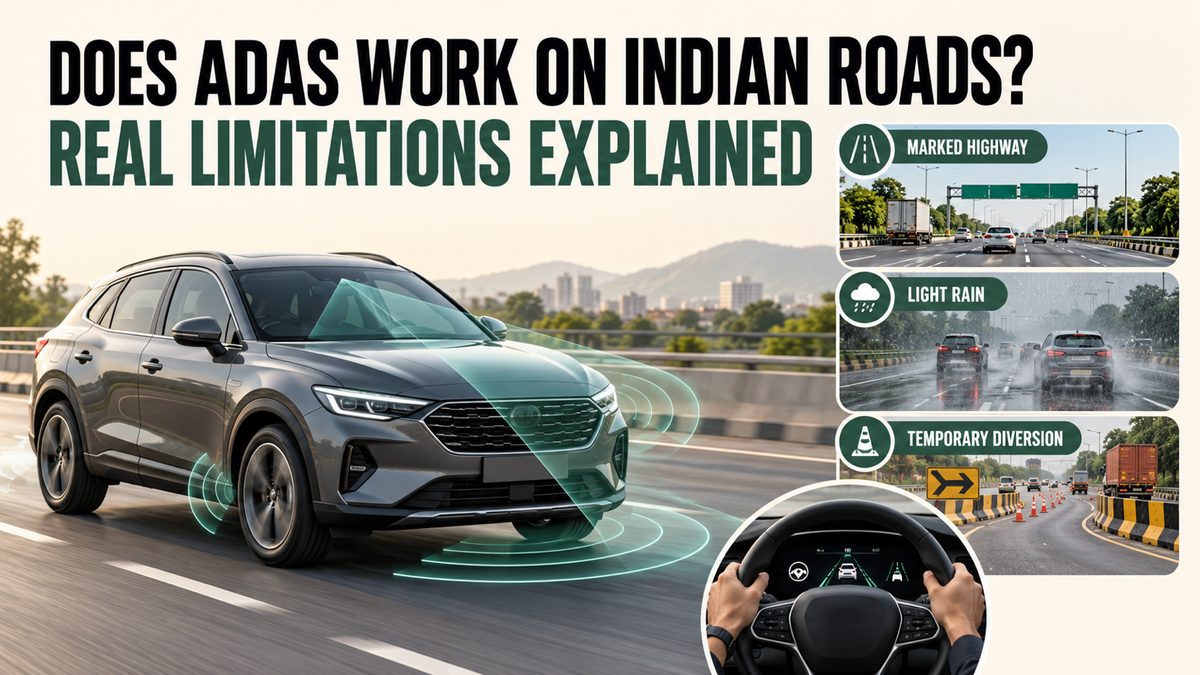
ADAS can provide useful assistance on Indian roads when the specific function is used within its documented operating conditions. It is not reliable in every traffic, weather or road situation. The right question is whether a particular function suits a particular journey, not whether the whole technology works everywhere or nowhere.
The driver must remain attentive and in control. Read the Indian vehicle's manual, distinguish warnings from steering or braking assistance, and respond to limitations early. Do not treat Level 2 equipment as permission to stop supervising the road.
One label covers several different jobs
ADAS can describe collision warnings, emergency interventions, lane functions, cruise assistance and other equipment. These tasks use different information and have different limits. A useful parking-related function does not prove that lane assistance can manage an unmarked road.
Identify the function by name before evaluating it. Ask what it detects, what action it takes and what the driver must do. Saying the car has ADAS is less useful than knowing whether a feature warns, brakes or supports sustained control.
Compare your ordinary journeys with those documented conditions. A regular route with clear markings differs from a narrow market street with pedestrians and parked vehicles. Neither experience should be used as a universal judgement about every function in every car.
Marked roads and unclear road boundaries
Lane-related assistance may depend on recognising road markings or edges. Hyundai's Indian Ioniq 5 manual describes limitations where markings or boundaries are covered by rain, dirt and other material. This is an example from a particular manual, not a specification for all Hyundai cars.
For a buyer, the practical check is whether the relevant manual permits use on the roads you regularly travel. Do not assume a temporary painted line, repaired road surface or construction diversion will be interpreted correctly.
When the road layout is uncertain, the driver must establish a safe path. Do not wait for a steering alert before acting. A system that worked on the previous stretch has not promised to understand the next diversion.
Mixed traffic requires more than object detection
Indian journeys can involve vehicles entering a lane, two-wheelers moving close by and pedestrians near the carriageway. Detection and response vary by system. Do not assume every object type, movement or angle is covered just because an advertisement shows a traffic graphic.
Kia's Indian EV9 forward-collision guidance lists limitations involving conditions such as heavy rain or fog and sudden changes by a vehicle or powered two-wheeler ahead. Use that as a reminder to read your own car's limits, not as evidence that every other model has the same detection performance.
Maintain observation and appropriate space. Assistance should not encourage a tighter gap because you expect automatic braking. The driver still needs room and time to respond to a developing situation.
Weather can change a familiar journey
Good performance on a dry afternoon does not establish performance in a monsoon downpour or fog. Visibility and sensor conditions can change. The system may warn, become unavailable or behave differently within the limits described by the manufacturer.
Plan to drive safely without assistance whenever conditions require it. Reduce risk through appropriate speed, visibility and distance rather than expecting technology to compensate. Do not continue at a speed that depends on an assistance function remaining active.
If a warning appears, follow the manual. Stop safely before inspecting accessible sensor areas or changing settings that require attention. Do not attempt repairs or adjustments while moving.
A route-based way to assess usefulness
| Journey condition | What to check in the manual | Sensible expectation |
|---|---|---|
| Clear marked intercity road | Permitted road type and operating range | Assistance may be usable within stated conditions |
| Narrow unmarked street | Lane-function limitations | Driver judges the path directly |
| Dense mixed traffic | Detection, speed and cut-in limitations | No assumption that every movement is recognised |
| Heavy rain or fog | Visibility and sensor restrictions | Be prepared for reduced or unavailable assistance |
| Temporary diversion | Road-layout limitations | Follow signs and direct observation |
| Recent repair | Required inspection or calibration | Confirm proper checks before relying on equipment |
This table is a buying framework, not a list of approved operating conditions. The actual vehicle's instructions take precedence for each function.
Warnings are not guarantees of intervention
A forward warning and automatic braking are different actions. A system may alert without taking the action you expected, or its intervention may be limited. Learn the sequence described in the manual rather than assuming the car will always stop.
The absence of a warning is not proof that the road is clear. Continue looking for hazards and driving normally. A function can fail to recognise a situation without first delivering a useful advance explanation.
Do not build a driving habit around testing the last possible moment for intervention. Deliberately approaching an obstacle to see what happens creates risk for people who did not agree to your experiment.
Cruise assistance needs its own judgement
Distinguish conventional cruise control from adaptive cruise control. Confirm how the particular function handles a vehicle ahead, what speeds are supported and which conditions exclude use. Do not infer stop-and-go capability from the word adaptive alone.
At junctions, toll approaches, unusual obstacles or changing traffic layouts, follow the documented restrictions and remain ready to control the car. The system's ability to maintain a gap in one situation does not establish that it understands the whole road context.
Ask how to cancel and resume the function safely. Learn the controls while parked, then use them only when appropriate. A complicated menu should not become a distraction during a demanding section of the route.
Driver monitoring does not transfer responsibility
SAE's classification keeps continuous driver supervision necessary for Level 1 and Level 2 support. A reminder to hold the wheel or look ahead is not an invitation to disengage until the reminder sounds.
Follow the car's instructions for attention and hand placement. Do not attach devices intended to defeat monitoring or simulate driver input. Such behaviour removes a safeguard while leaving the system's limitations unchanged.
If you find the equipment distracting or difficult to understand, stop safely and consult the manual or authorised representative. Do not experiment with critical settings while trying to handle traffic at the same time.
Keep sensors and repairs within the approved process
Check the manual's instructions for keeping relevant camera and sensor areas unobstructed. Avoid accessories, stickers or modifications in prohibited locations. A cosmetic change near a sensor should not be assumed harmless without manufacturer guidance.
After relevant windscreen, bumper or sensor work, ask whether an inspection or calibration is required. Keep the repair record. A clear display or absence of an obvious warning is not a substitute for a required workshop procedure.
If assistance behaves unusually after a repair, stop relying on the affected function and seek authorised assessment. Describe the circumstances accurately. Do not try to solve the issue by concealing the warning or repeatedly resetting it.
Use a test drive to learn controls rather than prove a claim
Ask the representative to explain the equipment before leaving. Establish which trim and transmission the demonstration car has and whether it matches your quotation. A higher version may not represent the one you plan to buy.
Take an ordinary, lawful test drive on a suitable route. Observe whether displays and controls are understandable while remaining responsible for driving. Do not deliberately drift, tailgate or aim at an object to trigger assistance.
Ask for the manual sections covering the roads you use most. Record unanswered questions and request a written explanation. A clear limitation is useful buying information, not something to dismiss because it interrupts a demonstration.
Decide whether the extra cost fits your use
List the functions you expect to use and the journeys where they are permitted. Compare the price of the actual equipped trim, not the model's starting price. Separate assistance benefits from comfort features bundled into the same upgrade.
Consider the car's seating, visibility, brakes, crash assessment and service access too. An assistance package should not compensate for a vehicle that otherwise fails your household's needs. Keep essential insurance and maintenance within the budget.
For an infrequent compatible journey, you may value the package differently from a daily highway commuter. There is no need to invent a universal payback figure. Buy based on documented capability and realistic use rather than fear of missing a label.
What a fair conclusion about Indian roads looks like
Avoid both extremes: the claim that assistance makes driving automatic and the claim that every function is useless across India. Roads, weather and systems differ. A useful assessment states the function, vehicle, conditions and evidence.
Owner reports can suggest questions but do not establish performance for every car. A video showing one successful intervention is not a controlled reliability study. An isolated failure report also needs context before being generalised.
Use official instructions as the starting point and seek service support for faults. Continue to treat attention, space and safe speed as the main responsibilities of the person driving.
Frequently asked questions
Can ADAS be useful in India?
Yes, within the particular system's documented conditions. Its usefulness depends on the function, vehicle and journey. It is not a promise of correct operation everywhere.
Can I rely on lane assistance on unmarked roads?
Do not assume that capability. Check the exact manual and maintain direct control of the vehicle's path when conditions are outside the function's intended use.
Does automatic braking detect every obstacle?
No universal detection claim is justified. Read the listed object and operating limitations and remain ready to brake yourself.
Can rain affect driver assistance?
Yes, relevant manuals describe visibility and sensor limitations. Follow the vehicle's restrictions and be prepared to drive without the affected assistance.
Should I test the system by creating a dangerous situation?
No. Do not deliberately approach people, vehicles or obstacles. Use an approved explanation or controlled manufacturer demonstration.
Match the equipment to your normal route
Read the manual, identify the functions and discuss your regular road conditions with an authorised representative. Take a normal test drive and compare the equipped variant's total cost. Keep the driver's role clear throughout ownership.