



Quick answer
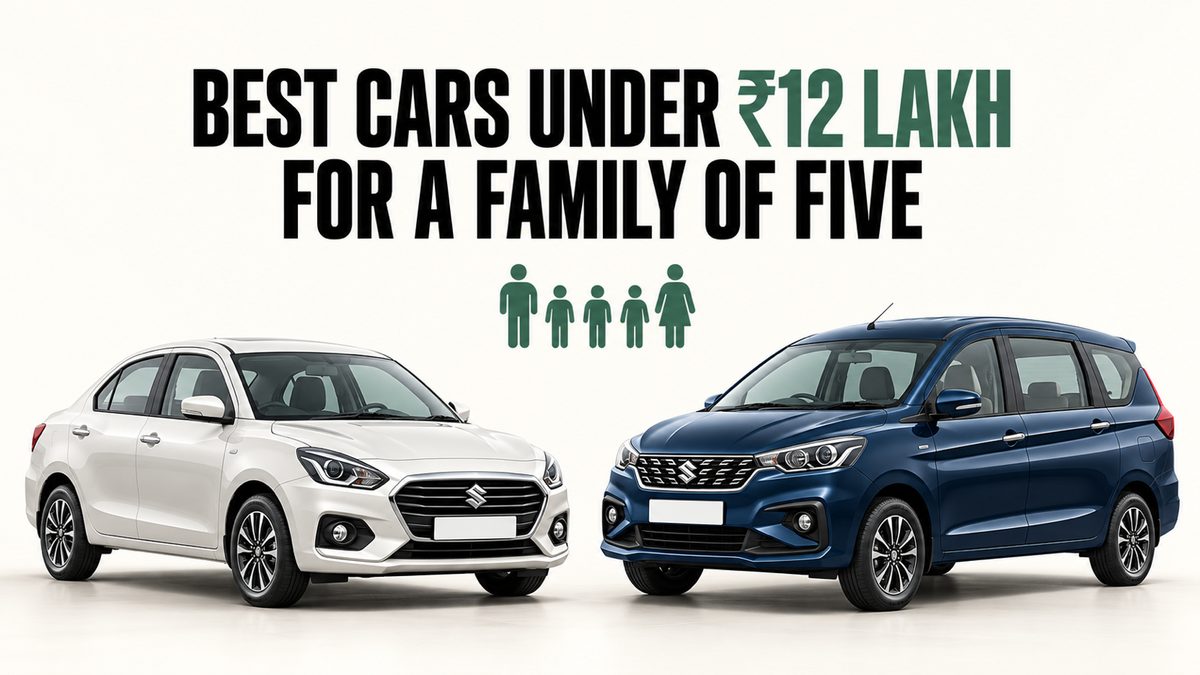
The Maruti Suzuki Baleno and Dzire, Hyundai Exter and selected Maruti Suzuki Ertiga variants are useful starting points for a family of five with a ₹12 lakh ex-showroom budget. They cover a hatchback, sedan, small SUV and MPV, so the right choice depends on passenger size, luggage and how often all five people travel together.
A family with three adults in the rear should place seat width and the centre position ahead of a long feature list. Two adults and three children have different needs, especially when child restraints occupy the outer seats. Bring everyone to the showroom before deciding. A five-seat specification does not promise equal comfort for five adults.
Decide whether ₹12 lakh is the full purchase limit
This article uses ex-showroom prices. Registration, insurance and selected extras cost more. If ₹12 lakh is your total cash or finance limit, obtain an itemised on-road quotation before choosing a trim. A vehicle listed close to ₹12 lakh ex-showroom may exceed that ceiling by a sizeable amount.
The figures below were checked against manufacturer information for this update. Hyundai Exter figures are from its March 2026 launch table. They are a dated reference, so request the current invoice price. Exact equipment, paint charges and availability also need checking for the variant you order.
A practical family shortlist
| Model and example variant | Ex-showroom price | Format | First thing to test |
|---|---|---|---|
| Maruti Suzuki Dzire VXi AMT | ₹7,72,100 | Sedan | Rear centre-seat comfort |
| Maruti Suzuki Baleno Delta AGS | ₹7,49,900 | Hatchback | Three-person rear seating |
| Hyundai Exter HX 6 AMT | ₹8,54,900 | Small SUV | Entry and luggage fit |
| Maruti Suzuki Ertiga VXi MT | ₹9,95,300 | Seven-seat MPV | Five-person seating plan |
| Maruti Suzuki Ertiga VXi AT | ₹11,30,300 | Seven-seat MPV | On-road budget headroom |
These examples establish that qualifying variants exist. They are not a measured ranking of rear-seat space. Your passengers should judge the fit in person, including the exact child seats and luggage you use.
Maruti Suzuki Dzire for luggage and daily family use
The Dzire is worth comparing when you prefer a sedan and regularly carry shopping, school bags or travel cases. Maruti Suzuki's brochure specifies five seats and a 382-litre petrol boot. The current price page lists the VXi AMT at ₹7,72,100 and ZXi AMT at ₹8,72,700, leaving room within the ex-showroom ceiling.
Assess the rear bench with the front seats set for your actual drivers. Sit in the middle position and check knee clearance, foot placement and shoulder contact. If a child seat is fitted on either side, repeat the test with it installed. A bench can feel acceptable with two passengers and much tighter after the third arrives.
Load your usual suitcases through the boot opening. Published volume does not show whether a particular pushchair or tall bag will fit. Buyers considering CNG should inspect that version separately because its cylinder changes the luggage arrangement.
Maruti Suzuki Baleno for a hatchback layout
NEXA lists the Baleno Delta AGS at ₹7,49,900 and Zeta AGS at ₹8,49,900 on its official city-linked price page. The current specification display lists five seats and a 318-litre petrol boot. That makes it a relevant hatchback alternative within this budget.
The key comparison is how the passenger and luggage spaces work together for your family. Check the rear centre position, door openings and the route for passing a child into a fitted restraint. Avoid judging the car while the driver's seat is pushed unusually far forward by a showroom demonstrator.
A hatchback opening can help with bulky items, but shape matters more than the body-style label. Try your pushchair, a weekly shopping load or the bags used for a weekend trip. Keep heavy objects secured and below the parcel shelf where practical so they do not obstruct rear visibility.
Hyundai Exter for an upright seating position
Hyundai's March 2026 announcement lists the Exter HX 6 AMT at ₹8,54,900 and HX 8 AMT at ₹9,07,900. It states that six airbags, electronic stability control and hill-start assistance are standard across the updated range. Hyundai gives a petrol boot figure of 391 litres and 225 litres for its dual-cylinder CNG arrangement.
Compare entry and exit with the family members who find low seats difficult. An upright body may be appealing, but the seat height, sill and door angle must work for each passenger. Check whether an older relative can sit down and stand up without twisting awkwardly.
For three rear occupants, perform the same shoulder-room test used in the hatchback and sedan. SUV styling does not automatically create a wider bench. Confirm the chosen variant's parking aids and try reversing into a space similar to the one at home.
Maruti Suzuki Ertiga when flexibility matters
The Ertiga has seven seats, but it can also serve a household of five. Its third row folds to change the balance between passengers and luggage. The official price page lists the VXi manual at ₹9,95,300, ZXi manual at ₹11,01,500 and VXi automatic at ₹11,30,300. Each is below ₹12 lakh ex-showroom.
Try two different seating arrangements. First, seat three people in row two with the third row folded. Then, if needed, place one passenger in row three and check access, comfort and the remaining luggage area. Every passenger needs an appropriate restraint in the position used.
The extra length also matters. Measure your parking bay and check the building's turning space. A flexible cabin is useful only if the car is manageable on the routes and parking ramps you use daily. The automatic example leaves less room for taxes and insurance than the manual versions.
What five passengers should check together
Seat the regular driver first and adjust the front passenger seat normally. Only then place three people in the back. Sit for at least several minutes with doors closed. Notice whether shoulders are forced forward, knees contact the seatback or the centre passenger has nowhere comfortable to put their feet.
Check access to every belt buckle. A buckle hidden beneath a child seat or another passenger's hip is inconvenient and may prevent correct use. Ensure the belt sits properly across the body. Ask the dealer to demonstrate head-restraint adjustment and verify the arrangement for the exact trim.
Children should use restraints suited to their size and the vehicle's approved seating positions. Check both the vehicle manual and the restraint instructions. Do not assume two ISOFIX seats leave enough space for a third person between them. Test the actual combination before paying a deposit.
Compare safety equipment on the chosen variant
Ask for a dated equipment sheet showing the car's airbags, seat belts, head restraints, child-seat anchorages and stability control. Check parking aids as well, especially if the regular driver is moving to a larger vehicle. A camera helps with visibility but does not remove the need to check around the car.
If an independent crash rating is part of your decision, read the result for the relevant Indian vehicle and model year. Do not transfer a score from a different generation, export version or test protocol. The number of airbags alone does not establish crash performance.
Build the family shortlist around equipment and fit before comparing decorative extras. A feature that makes daily access, restraint use or parking easier can be more useful than a sunroof or a larger screen. Give each regular driver a chance to test the controls.
Match the engine and gearbox to your routine
For frequent crawling traffic, an automatic removes clutch-pedal work. Test the car slowly as well as on an open stretch because different gearboxes respond differently. Ask the representative to explain hill starts and parking procedures using the owner's manual.
For regular longer journeys with five people, check acceleration and braking feel with an appropriate passenger load during the test drive. Follow the manufacturer's load limits, including luggage. Do not use a lightly loaded showroom drive to assume how the car will behave on every family trip.
CNG may reduce fuel spending for some high-distance users, but the comparison also needs filling access, luggage space and the extra purchase cost. Obtain separate petrol and CNG quotations. Use your actual monthly distance rather than an optimistic saving claimed without clear assumptions.
Budget for the first year of ownership
Compare insurance on equivalent cover and excess terms. Request a service estimate and ask which consumables or wear items sit outside it. If financing, compare the down payment, loan tenure, interest rate and total repayment together. A lower monthly instalment can simply mean paying for longer.
Keep some money for family needs after delivery, such as a suitable child restraint or replacement of an unsuitable parking arrangement. Avoid adding accessories because they appear on a pre-filled dealer quotation. Ask which products are optional and decide separately.
Frequently asked questions
Is a seven-seater necessary for a family of five?
No. A five-seat car may work well if everyone fits with the correct restraints and luggage. A seven-seater adds seating flexibility, but it also needs more parking space and a different budget.
Which car should families with three rear passengers test first?
Compare at least two body styles with all three people present. Rear-seat shape, belt positions and child restraints can matter more than the advertised seating count.
Is ₹12 lakh enough for an automatic family car?
Several qualifying examples in this shortlist are below ₹12 lakh ex-showroom. Your local on-road quotation determines whether the selected variant fits a ₹12 lakh total budget.
Does a bigger boot number guarantee easier luggage loading?
No. The opening, floor shape and bags you carry affect usefulness. Try the actual luggage rather than comparing volume figures alone.
Should I buy the highest trim I can afford?
Choose it only when the additional equipment is useful to your family. Retaining money for ownership costs can be the more comfortable decision.
Compare two cars with the whole family
Book two test drives, carry your usual child restraints and bags, and request written quotations for the exact variants. Choose the car that fits all five passengers comfortably within your full purchase budget.
Related reading
- Best automatic cars under ₹10 lakh
- Best cars under ₹8 lakh with six airbags
- Manual vs automatic cars