



Quick answer
You can often skip unwanted cosmetic packages, duplicate roadside assistance, accessories already supplied with the car and cover that does not suit your needs. Ask for each item separately priced. Do not remove a genuine statutory requirement, essential safety equipment or maintenance specified by the manufacturer simply to reduce the bill.
The right decision depends on the product, its terms and the car. Extended warranty or a suitable camera may be useful to one buyer and unnecessary to another. This checklist helps you decide deliberately instead of accepting a single accessory bundle at booking.
Begin with a quotation without optional products
Ask the dealer for the vehicle price, applicable taxes and registration, and the insurance arrangement separately from accessories and services. This gives you a clear baseline. Then add products you actually want rather than negotiating from a package whose contents are unclear.
Have every optional item named precisely. Interior treatment is not a sufficient description if it combines several services. Ask what work is done, which product is used and what written protection, if any, follows the purchase.
If something is described as compulsory, request the legal, manufacturer or contract basis. Do not assume every dealer label represents a government charge. Equally, do not remove a genuine registration or insurance requirement because it appears beside optional items on the sheet.
Skip a bundle built around things you do not need
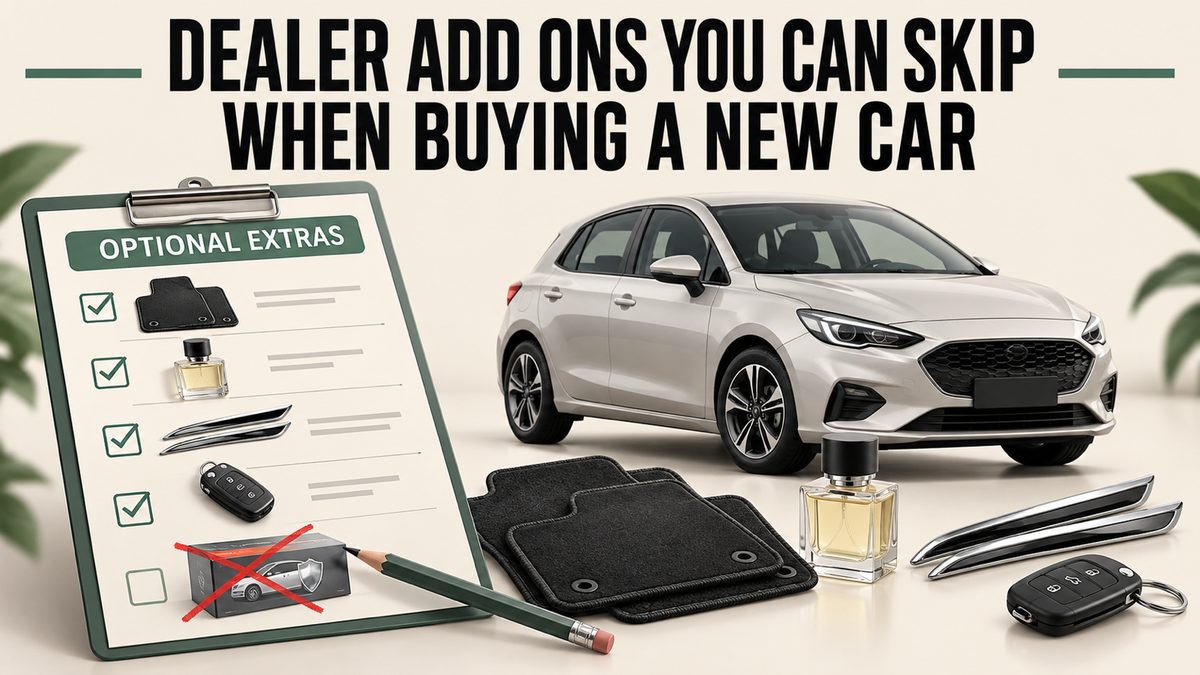
A basic accessory package may contain mats, perfume, trim pieces and other small items. Some may be useful, but the bundle price should be compared with the cost of the items you would choose individually.
Check whether any included part is already supplied with the selected variant. A photograph of a differently equipped car is not proof that you need to buy the same part again. Ask the dealer to identify factory equipment and accessories separately.
Do not value every included item at the seller's highest stated retail price. A free product that you would never purchase has limited value to your budget. Prefer a clear cash reduction or a smaller selection when the dealer is willing to offer it.
Cosmetic coatings need a specific reason
Paint protection, ceramic coating and interior treatments are optional buying decisions, not substitutes for careful washing or repairs. Ask what the treatment actually does and what it does not cover. Avoid interpreting a general protection claim as immunity from scratches or stone damage.
Compare preparation, product details, application standards and aftercare. A longer named package is not necessarily better work. If a warranty is included, identify who provides it, which defects qualify and what future maintenance is required.
You can defer a cosmetic purchase while researching it. Follow the manufacturer's care instructions for ordinary upkeep.
Underbody treatment is not automatically necessary for every buyer
Ask what corrosion protection the vehicle already has and what its warranty says. The benefit of an extra treatment depends on the car, product, application and use conditions. Avoid a nationwide rule saying every new vehicle either needs or never needs it.
Obtain written confirmation about compatibility, preparation and areas that must not be coated. Careless application near components can create concerns unrelated to the advertised protection. A low package price does not establish correct installation.
If your driving includes conditions that make you concerned about corrosion, discuss them with the manufacturer or a qualified workshop. Decide from the vehicle's requirements rather than a demonstration designed only to make an untreated panel look alarming.
Seat covers and mats need safety checks first
Do not buy a generic seat cover without checking compatibility with seat-mounted airbags and other fitted equipment. A seller's airbag-friendly label should be supported for the actual seat and installation. Use the car manufacturer's instructions when deciding what is allowed.
NHTSA's airbag guidance stresses following vehicle instructions and keeping deployment areas clear. The advice is relevant to an accessory decision, but the exact precautions come from your Indian vehicle's manual. Avoid covering labels or changing the intended deployment path.
Mats must fit securely without interfering with pedals. Do not stack an extra mat over another or select one only by thickness and appearance. Ask the dealer to demonstrate the approved retention and fit before paying for an accessory that sits in the driver's footwell.
Check whether roadside assistance is already included
Roadside assistance can be supplied through a vehicle programme, insurance add-on or another service. Record what you already receive before buying another membership. Duplicate products can add cost without adding the help you expect.
Compare towing limits, eligible locations, call-out restrictions and the difference between arranging help and paying every associated cost. A phone number available all day is not a promise of unrestricted free recovery anywhere.
Consider a second programme only if it fills a useful coverage gap.
Insurance add ons should match a real concern
Zero-depreciation, engine-related protection and return-to-invoice products have different purposes and conditions. IRDAI explains that add-ons extend base cover for an extra premium and that products differ between insurers. They should be chosen individually rather than assumed to be identical.
Ask for the policy wording and price of each chosen cover. Check claim limits, deductibles, exclusions and eligibility. A reassuring product name does not explain whether a particular repair or loss will qualify.
Do not reduce the premium by removing cover you need without understanding the risk retained. The useful saving is avoiding unsuitable or duplicate products, not buying a policy that cannot meet your intended protection requirement.
Extended warranty is a separate decision
An extended warranty may suit a buyer keeping the car beyond standard cover. It should not be rejected simply because it is sold at the dealership. Read the coverage, exclusions, time and kilometre limits, service obligations and claim process.
Maruti Suzuki's current warranty information distinguishes standard cover from paid extensions and says cost varies by vehicle and other details. That is a reason to obtain the exact quotation, not assume a single price or coverage period applies to all cars.
Ask whether you can decide later within an eligibility window and whether the price changes. Record the deadline if you defer. Skipping a product at booking is different from permanently losing the option, but the actual terms decide which situation applies.
Maintenance packages should not duplicate another plan
A prepaid maintenance plan pays for specified servicing. An extended warranty addresses qualifying failures. They are not the same product, even if both are sold as ownership protection.
Maruti Suzuki's maintenance information lists different package contents. Check the actual plan for your car, including parts, labour, consumables and any excluded work. Do not assume the phrase service package means every workshop bill is included.
Compare the package with the scheduled services you are likely to use during its validity. If the plan expires before you reach much of its mileage allowance, a large allowance may have little practical value. Keep a separate budget for excluded wear and repairs.
Use a product by product decision sheet
| Product | Reason to consider it | Reason to decline or defer |
|---|---|---|
| Cosmetic coating | You understand preparation and aftercare | Vague protection claim or unwanted spend |
| Seat covers | Approved fit for the actual seat | Unclear airbag compatibility |
| Mats | Secure fit without pedal obstruction | Poor fit or stacked installation |
| Roadside assistance | Fills a clear coverage gap | Duplicates existing useful cover |
| Insurance add-on | Addresses a relevant insured risk | Unsuitable terms or overlapping cover |
| Extended warranty | Covers your intended ownership period | Little usable extension or exclusions |
| Maintenance plan | Useful scheduled work at a fair cost | Wrong duration or duplicated servicing |
This sheet does not make all products necessary or unnecessary. It gives each purchase a reason that can be checked against a written document.
Electrical accessories deserve installation scrutiny
Dashcams, cameras and audio equipment can be useful. Check the product's compatibility, power arrangement and installation method before choosing the cheapest bundle. Ask how work affecting wiring will be documented and how any related issue will be handled.
Do not accept a broad claim that every aftermarket accessory cancels every warranty, or the opposite claim that installation can never affect cover. The product, cause of a fault and applicable warranty terms matter. Obtain vehicle-specific written guidance.
Avoid an accessory that obstructs the driver's view or interferes with sensors. A neat appearance is not enough to establish safe placement. Follow the vehicle and product instructions and confirm that the chosen installation does not compromise normal controls.
Check the revised total before paying
When you remove an item, ask whether any conditional discount changes. Compare the final total after that change. A dealer may be willing to replace a bundle with a smaller useful selection, but you need the actual revised figure.
Keep the final order explicit. It should list agreed products, their prices and any promised installation or documentation. At delivery, check that unwanted work has not been added and that approved accessories match the order.
Retain invoices and warranty documents for the products you keep. A handwritten promise of free support is less useful than the provider's actual terms and purchase record. Good records also make it easier to identify what was fitted if a concern arises later.
Questions about dealer extras
Can I ask for a car without an accessory package
Yes, ask for a quotation without optional products and request an explanation for anything described as compulsory. Check the specific offer conditions rather than assuming every advertised benefit remains unchanged when a package is removed.
Is an extended warranty the same as insurance
No. Their purposes and terms differ. A warranty addresses specified qualifying failures, while motor insurance covers defined insured risks. Read both documents instead of assuming one makes the other unnecessary.
Should I buy every insurance add on
No. Choose suitable cover after checking price, exclusions and your needs. Avoid duplicate protection, but do not remove something important merely because the premium becomes smaller.
Is a free coating worth the advertised price
Only if you want the service and understand its quality and conditions. Compare the final car price without it. A seller's stated value is not automatically the amount you save.
Can I add accessories after delivery
Many products can be considered later, subject to compatibility and installation requirements. Check deadlines for warranty or plan purchases separately. Do not assume every time-limited protection product can be bought whenever you want.
Ask for only what you need
Request a revised quote with optional extras separated and approve each one deliberately. Keep essential safety and statutory requirements intact. Spend on products that solve a real need, with clear terms and a suitable installation, rather than filling a package to make the discount appear larger.
Related reading
- On-road price calculation explained
- New car discount negotiation guide
- Is extended warranty worth it