



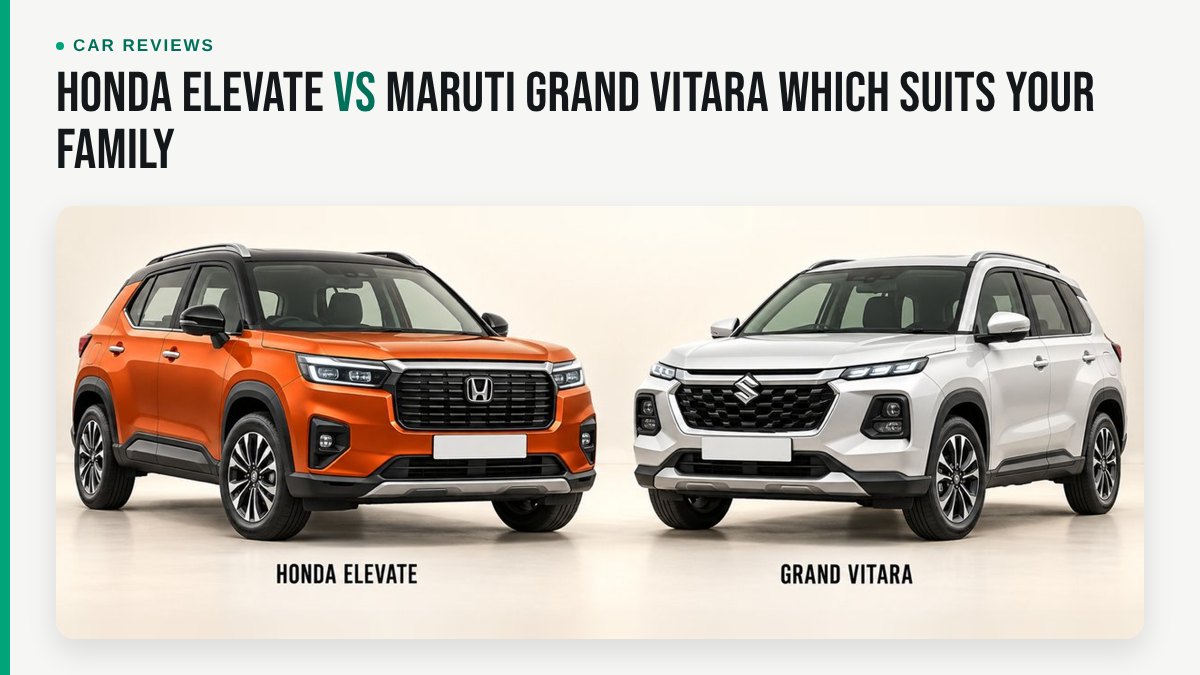
Quick answer
Consider the Honda Elevate if you want a 1.5-litre petrol SUV with manual or CVT transmission and the cabin suits your family. Consider the Maruti Grand Vitara if you want to compare regular petrol with strong-hybrid ownership or need to assess an available ALLGRIP version.
The important comparison is not simply Honda against Maruti. An Elevate CVT, a Grand Vitara petrol automatic and a Grand Vitara strong hybrid have different prices and operating arrangements. Compare the exact versions within budget, then test seating, luggage and your normal commute.
Identify the three purchases hidden inside this question
Honda's current specification information lists the Elevate's 1.5-litre petrol with a six-speed manual or CVT. NEXA's Grand Vitara information separates petrol, strong hybrid and ALLGRIP offerings. Choosing a badge before selecting the powertrain can lead to comparing cars intended for different priorities.
| Your requirement | Elevate to assess | Grand Vitara to assess |
|---|---|---|
| Petrol with manual gears | 1.5 petrol manual | Current petrol manual combination |
| Petrol without a clutch pedal | CVT | Current petrol automatic combination |
| Strong hybrid | Not the petrol Elevate described here | Strong-hybrid version |
| Extra driven-wheel capability | Do not assume it from SUV styling | Confirm ALLGRIP specification |
| Family practicality | Inspect actual seating and luggage | Inspect the chosen powertrain version |
This comparison focuses on petrol and strong-hybrid choices. Any CNG proposal needs its own current specification, warranty and fuel-access check. Do not assume an accessory or conversion is equivalent to a factory powertrain because it appears on a dealer quotation.
What a strong hybrid changes
The Grand Vitara strong hybrid can use its engine and electric motor in different operating modes, with battery energy managed by the vehicle. It is not a battery-electric car that you normally plug into a home charger. NEXA describes electric, petrol-only and combined operation.
The regular petrol version uses a different assistance arrangement. Do not assume the word hybrid on two quotations means equal electric-driving capability. Ask the dealer to identify the exact powertrain and explain what the driver needs to do in normal use.
For a buyer who wants to avoid planning charging stops, a non-plug-in hybrid is a different proposition from an EV. It still consumes petrol, needs scheduled servicing and has operating limits. It should not be described as free electric travel or zero fuel cost.
Compare the purchase premium before promising savings
Obtain the on-road difference between the actual strong-hybrid variant and the petrol SUV you would otherwise choose. Similar equipment helps, but record any mismatch. Do not attribute the entire difference to hybrid technology if one quote also includes a higher trim or additional accessories.
Estimate annual fuel spending from your distance, local petrol price and realistic consumption assumptions. Keep the inputs visible. A certified mileage figure is useful reference information, but congestion, journey length, load and driving style can change the result.
If the hybrid costs more initially, divide that extra amount by the estimated annual fuel saving to understand a simple payback period. Then examine financing and maintenance separately. This is a comparison method, not a guarantee that a particular household will recover the premium.
A labelled example shows why distance matters
Assume, only for illustration, that two SUVs cost ₹7 and ₹5 per kilometre in fuel on your expected usage. The difference is ₹2 per kilometre. At 10,000 kilometres a year that represents ₹20,000; at 20,000 kilometres it represents ₹40,000.
If the assumed additional purchase cost were ₹2 lakh, simple fuel-only recovery would take ten years in the first case and five in the second. These are invented calculation inputs, not measured results, current prices or a claim about either model's efficiency.
The example explains why a high-distance owner can reach a different decision from a low-distance owner. Interest, maintenance, insurance, resale and changing fuel prices are excluded here. Add them before using a cost estimate as the basis for a purchase.
Test the Elevate CVT and petrol Grand Vitara separately
A buyer who does not want the hybrid premium should still compare the two petrol automatics carefully. A CVT and a conventional stepped automatic do not operate identically. The absence of a clutch pedal is only the starting point of the test.
Try gentle acceleration, joining normal traffic, low-speed parking and slowing for speed breakers. Ask whether the engine response and sound are comfortable for you. Test both on comparable roads with the usual air-conditioning setting rather than comparing one short drive with a much longer one.
Read the operating and maintenance guidance for the actual gearbox. Do not assume that a transmission nickname proves long-term reliability or that one internet account predicts every owner's experience. Local support and correct servicing belong in the assessment.
Family luggage can matter more than fuel figures
Honda's current specifications quote 458 litres of luggage capacity for the Elevate. Treat that as a published reference, then bring the bags or folded pram you use. A volume number does not tell you whether a bulky item will pass through the opening.
Inspect the Grand Vitara in the powertrain form you intend to buy. Do not judge a strong-hybrid boot from a petrol display vehicle or assume all layouts are identical. Check the luggage floor, folding seats and access to essential equipment.
If every seat is occupied on regular journeys, test the luggage space with the seats in that configuration. Folding the rear seat to demonstrate a large object does not solve the same family trip. Keep rear visibility and secure loading in mind.
Bring rear passengers to the showroom
Set the front seats for their usual occupants. Ask rear passengers to check knee room, space for feet, head clearance and the backrest position. Older family members should try entry and exit rather than relying on a younger buyer's impression.
Fit the child seat you plan to use where possible. Confirm the approved installation method and access to adjacent belts. If three people often sit across the rear, test that exact arrangement instead of assuming comfort from two empty outer seats.
Check the small conveniences you use daily: bottle storage, charging access, air flow and visibility from the rear. A fuel-saving powertrain can be attractive, but it should not require ignoring a seating arrangement that does not work for your family.
Ground clearance does not establish off road ability
Do not treat SUV styling or a ground-clearance figure as evidence of all-wheel drive. If additional traction is a genuine need, ask for the exact Grand Vitara ALLGRIP configuration and its operating limits. The regular petrol and strong-hybrid versions are not automatically the same purchase.
Describe the roads you expect to use. A steep paved driveway, loose village approach and serious off-road route are different situations. Tyres, load and driver technique also affect what is sensible, so avoid choosing from a dramatic advertising photograph.
If your use is ordinary commuting and family trips, confirm whether extra driven-wheel hardware is necessary at all. It may add purchase and ownership cost without addressing your main requirement. A comfortable, affordable road-going version can remain the more suitable option.
Safety features need a variant level check
Honda's current Elevate pages list six airbags and identify Honda SENSING functions on selected grades. NEXA currently lists six airbags as standard on the Grand Vitara. Verify the full delivered specification, including restraints and child-seat provisions, rather than comparing only the headline count.
ADAS functions and cameras require separate checks. Ask which are fitted to the quoted variant and how their operating limits affect normal use. A higher grade with more assistance equipment does not guarantee avoidance of every accident.
If a crash rating is quoted, request the actual programme record, tested model, year and applicability. Do not borrow a result from another country's related vehicle. An equipment list and a crash assessment answer different questions and should remain clearly labelled.
Current features should not be taken from an old brochure
The current Honda page displays features that differ from early Elevate launch material, including equipment associated with higher grades. Compare the current feature matrix for your trim rather than assuming an older review has the final word on available convenience equipment.
Make a short list of items you need and operate them while parked. Check temperature controls, phone connection and parking displays in the actual demonstration car. Then confirm which of those items are fitted to the booked version.
Keep optional accessories separate. A dealer-fitted screen or camera should not be described as factory equipment without confirmation. Ask how installation affects warranty and whether the cost is genuinely necessary for your use.
Ownership support and warranty need written details
For each chosen powertrain, request the service schedule and applicable warranty documents. With the strong hybrid, ask specifically about battery and hybrid-component coverage, time and distance limits, exclusions and the process for a fault. Do not substitute a verbal promise of lifetime protection.
Locate the workshop you would use and check its appointment process. Ask whether the required support is available there or at another branch. Travel and time away from work are practical ownership costs even when the service invoice is modest.
Compare insurance on matching terms and obtain the total loan repayment if financing. Resale should remain an estimate, not an assured recovery of the hybrid premium. Make the purchase affordable before relying on a future sale price.
Questions about Elevate and Grand Vitara
Is the Grand Vitara strong hybrid an EV
No. It combines petrol and electric operation and still uses petrol. It is not the same ownership arrangement as a battery-electric vehicle requiring routine external charging.
Does the Elevate offer a diesel engine
Honda's current specification information says it is not available as a diesel. The petrol manual and CVT choices are the relevant versions in this comparison.
Will the hybrid premium always pay for itself
No. Recovery depends on the price difference, distance, fuel spending and ownership period. Calculate with your own assumptions and include costs beyond fuel.
Which has better family space
Test the actual seating and luggage requirements. Inspect the chosen Grand Vitara powertrain version rather than relying on another version's boot layout.
Does every Grand Vitara have ALLGRIP
No. Confirm the specific ALLGRIP variant and powertrain. Do not assume four-wheel capability from the model name or SUV appearance.
Compare the exact petrol and hybrid quotes
Test the Elevate CVT, the relevant Grand Vitara petrol and the strong hybrid if it fits your budget. Carry passengers and luggage, request written warranty terms and calculate fuel spending with realistic inputs. Choose the arrangement that works for your family over the full ownership period.
Related reading
- Honda Elevate variants explained
- Maruti Grand Vitara variants explained
- On-road price calculation explained