



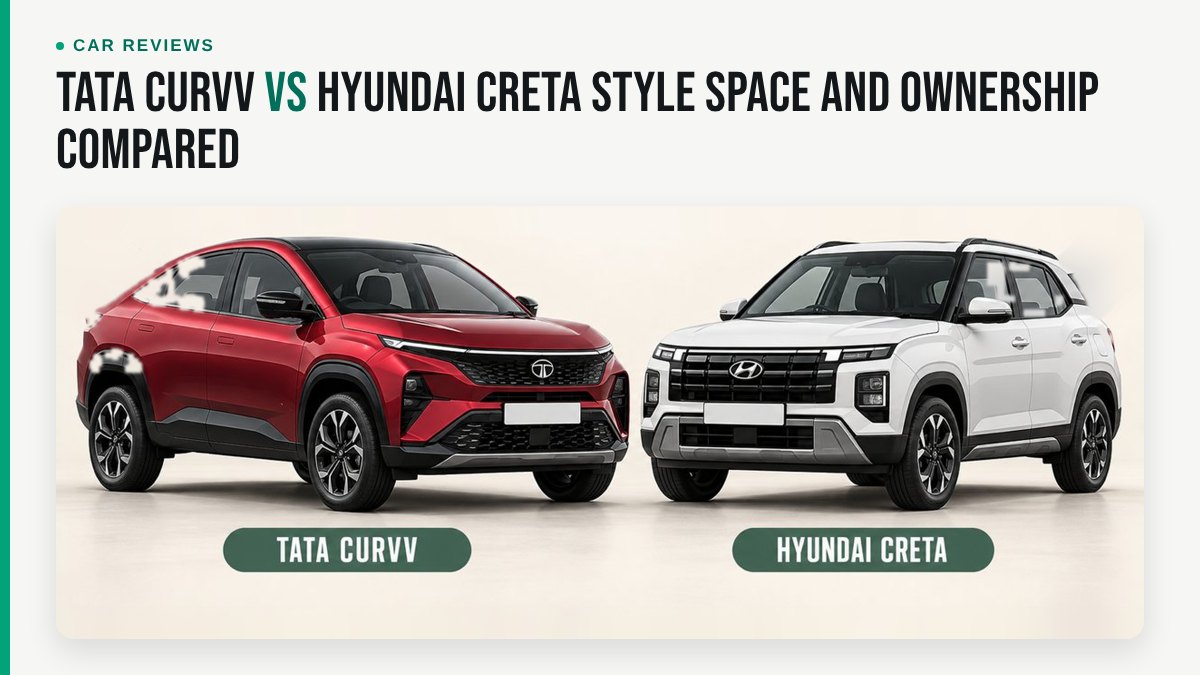
Quick answer
Choose between the Tata Curvv and Hyundai Creta after checking the exact engine, gearbox and family-space requirements. The Curvv's sloping roof is a reason to inspect rear access carefully, not proof that the cabin will or will not suit you. The Creta offers naturally aspirated petrol, turbo petrol and diesel combinations.
Start with two versions inside the same on-road budget. Bring regular passengers and luggage, then compare test drives and written quotations. This article compares manufacturer information and buying considerations; it does not present invented driving impressions.
Keep electric versions outside this comparison
The Curvv and Curvv.ev have separate powertrain and charging requirements. Hyundai also has a separate Creta Electric. This article concerns petrol and diesel vehicles. A similar body or model name does not make an EV and combustion-engine quote directly comparable.
If you want electric ownership, assess home charging, long-distance routes and battery terms separately. Do not add a claimed EV running cost to a petrol vehicle's purchase price or use the electric model's specification to describe the car in the showroom.
Tata's current model page uses Curvv Series X branding. Check the latest orderable trim rather than assuming the original launch ladder still describes the entire range. Record model year, fuel, gearbox and variant on each quotation.
Engine choices create different comparisons
Tata's current Curvv page identifies Revotron petrol, Hyperion direct-injection petrol and KryoJet diesel choices. Hyundai lists 1.5-litre petrol with manual or IVT, turbo petrol with DCT, and diesel with manual or automatic. Match the actual powertrain before judging value.
| Your priority | Curvv to investigate | Creta to investigate |
|---|---|---|
| Petrol manual | Current Revotron combination | 1.5 petrol manual |
| Petrol without a clutch pedal | Current DCA combination | Petrol IVT or turbo DCT |
| Diesel manual | Current KryoJet combination | 1.5 diesel manual |
| Diesel without a clutch pedal | Confirm current diesel DCA trim | 1.5 diesel automatic |
| Higher performance petrol | Hyperion configuration | Turbo-petrol DCT configuration |
This is a shortlist, not confirmation that every powertrain is fitted to every trim. Ask the dealer to identify the exact combination on the manufacturer's current matrix. Similar prices can conceal different engine specifications or equipment.
Understand which petrol automatic you are testing
A Creta petrol IVT and a turbo-petrol DCT are not the same purchase. The Curvv's DCA designation also needs to be tied to its actual engine and grade. Do not treat a single automatic demonstration as evidence for every version of the model.
Drive the intended car through the situations you repeat most. Try gentle starts, slow queues, parking and a normal change of pace on a suitable road. Set the air conditioning as you normally would and include regular passengers where permitted.
Ask for operating instructions and scheduled maintenance requirements. Decide whether the response suits the usual driver rather than relying on a gearbox label as a guarantee of comfort or reliability. Include the automatic premium in the complete ownership budget.
The roof shape needs a passenger test
The Curvv's coupe-style profile makes rear entry, head clearance and outward visibility worth checking early. That does not justify assuming every tall passenger will be uncomfortable. The relevant answer comes from the people who will actually sit there.
Set the front seats correctly, then ask rear passengers to sit naturally. Check the door opening, roof clearance while getting in, space above the head and room for feet. Try the middle position if three rear occupants are common.
Repeat the same inspection in the Creta. A more upright outline does not replace a real seating check. Seat shape, posture and the chosen front-seat position can affect comfort independently of the exterior silhouette.
Check visibility from the normal driving position
Adjust the seat and mirrors before judging the view. Check the front corners, nearby pedestrians and the view when turning at a junction. Ask whether the driver can place the car comfortably in a narrow lane without relying entirely on a screen.
Inspect the rear window and camera views on the quoted trim. Parking aids have blind spots and may differ between grades. A demonstration vehicle with extra cameras should not create an expectation that the lower version has identical equipment.
If your building has a tight entrance, measure the approach as well as the bay. Door-opening room and the turning space around a pillar can be more important than whether a vehicle fits inside a rectangle on paper.
Luggage capacity and useful loading space are different
Tata's published Curvv material identifies a 500-litre boot. Treat that as reference information rather than proof that every large item will fit. A sloping rear opening, loading edge and the shape of the object can change everyday usefulness.
Bring your normal suitcases, folded pram or other bulky item to both demonstrations. Load them with the rear seat in the position required for passengers. Check that the tailgate closes normally and that luggage can be secured without blocking visibility.
Inspect the spare wheel or repair equipment in its normal place. Do not compare a cleared-out display boot with a fully equipped car. If a rear seat must be folded for every routine trip, confirm that the remaining seating still meets your family's needs.
Diesel should follow your journey pattern
Both ranges contain diesel choices, but the decision is not settled by a lower assumed fuel bill. Start with annual distance and typical journey length. A week of short errands and an occasional highway holiday is different from regular longer commuting.
Read the emissions-system operating guidance and ask the service team about your normal use. Check local vehicle-use rules for where you expect to keep the car. Do not rely on an internet threshold saying every owner above one distance should buy diesel.
Compare the diesel premium against the petrol variant you would otherwise choose. Include interest, insurance and scheduled service. Use local fuel prices and labelled consumption assumptions rather than presenting a certified mileage figure as a guaranteed result on your route.
Safety records must match the vehicle
Check the current restraint, stability-control and child-seat specification for both quoted variants. If a crash result is used, record the programme, test year, tested version and applicable production coverage. A result from a related vehicle is not automatically transferable.
Keep crash evidence separate from equipment. Six airbags, a camera or driver assistance are useful facts only when their availability is confirmed. None establishes a guarantee about every collision or removes the need for correct seat-belt use.
Ask for a safe demonstration of assistance controls and alerts. Do not attempt a public-road emergency-braking test. Confirm operating limits and which functions belong to the exact engine and trim, particularly when comparing a showroom flagship with a lower-priced order.
Build the equipment list around ordinary use
List what matters on a normal working day. Easy temperature adjustment, phone connection, useful storage and comfortable seating may matter more than a cosmetic finish. Identify the lowest trim in each range that provides those items.
Try the controls while parked. Connect the phone you actually use, check the screen from the normal seat position and inspect charging access for passengers. Ask about subscriptions or paid services rather than assuming every connected function remains free indefinitely.
Compare the extra price of a higher grade with equipment you genuinely want. A sunroof or larger display can be enjoyable, but it should not displace the money needed for insurance, maintenance or a comfortable loan repayment.
Obtain quotations with the same assumptions
| Quote component | What to compare |
|---|---|
| Vehicle | Exact engine, gearbox, grade and model year |
| Registration | Same city and ownership category |
| Insurance | Similar cover, value and deductibles |
| Finance | Rate, fees, tenure and total repayment |
| Extras | Accessories and service products separately |
| Delivery | Written stock details and booking conditions |
Do not compare one dealer's accessory-heavy total with another's bare vehicle price. Ask which items are optional. A discount on older stock needs a separate specification and manufacturing-date check rather than being treated as a free upgrade.
An EMI by itself is not the vehicle cost. A longer term or larger down payment can make the monthly figure look attractive while changing total repayment. Keep the whole arrangement visible before deciding which quote represents better value.
Compare local support without assuming a national answer
Locate the workshop you would use for each brand. Check opening hours, appointment availability and travel time. Request the maintenance schedule and applicable warranty documents for your chosen engine and transmission, not a general model estimate.
Ask which service items are required and which are optional treatments. Obtain dated estimates where available and allow for consumables. Do not convert one owner's unusually low or high bill into a promise about your own costs.
Resale depends on condition, kilometres and future demand. Do not justify a budget stretch with a promised selling price.
A practical way to choose between the two
If the Curvv's styling is your main attraction, inspect access and luggage before the test drive. That lets a practical concern surface early. If the Creta is your default because it is familiar, still check the current specification and the exact budget alternative.
After both visits, record only differences that matter to you. These could be a more comfortable rear seat, easier parking, a preferred gearbox or a lower full purchase cost. Do not give equal weight to every brochure feature merely because it can be counted.
If uncertain, arrange a second drive with the same passengers and route. Choose for your own needs.
Questions about Curvv and Creta
Does this comparison include the electric versions
No. Curvv.ev and Creta Electric need separate charging and battery assessments. The petrol and diesel specifications here should not be applied to them.
Which should a petrol automatic buyer test
Compare the appropriate Curvv DCA with the Creta IVT or turbo DCT you can afford. Their engine and gearbox combinations differ, so confirm the exact demonstration version.
Is a sloping roof automatically unsuitable for families
No. Check entry, head clearance and visibility with your regular passengers. Exterior shape is a reason to inspect, not a substitute for that inspection.
Does the bigger published boot settle the decision
No. Load the items you normally carry and check the opening and seating configuration. A volume figure cannot describe every bulky object.
Should I buy diesel for occasional long trips
Not on that fact alone. Assess your usual journey pattern, total annual distance, applicable rules and full ownership costs before choosing fuel.
Compare two exact configurations
Shortlist a suitable Curvv and Creta at your actual on-road budget. Take passengers and luggage, test the intended gearbox and request matching insurance and finance quotations. Book after confirming the specification you will receive and the local support you will use.
Related reading
- Hyundai Creta variants explained
- On-road price calculation explained
- New car discount negotiation tips