



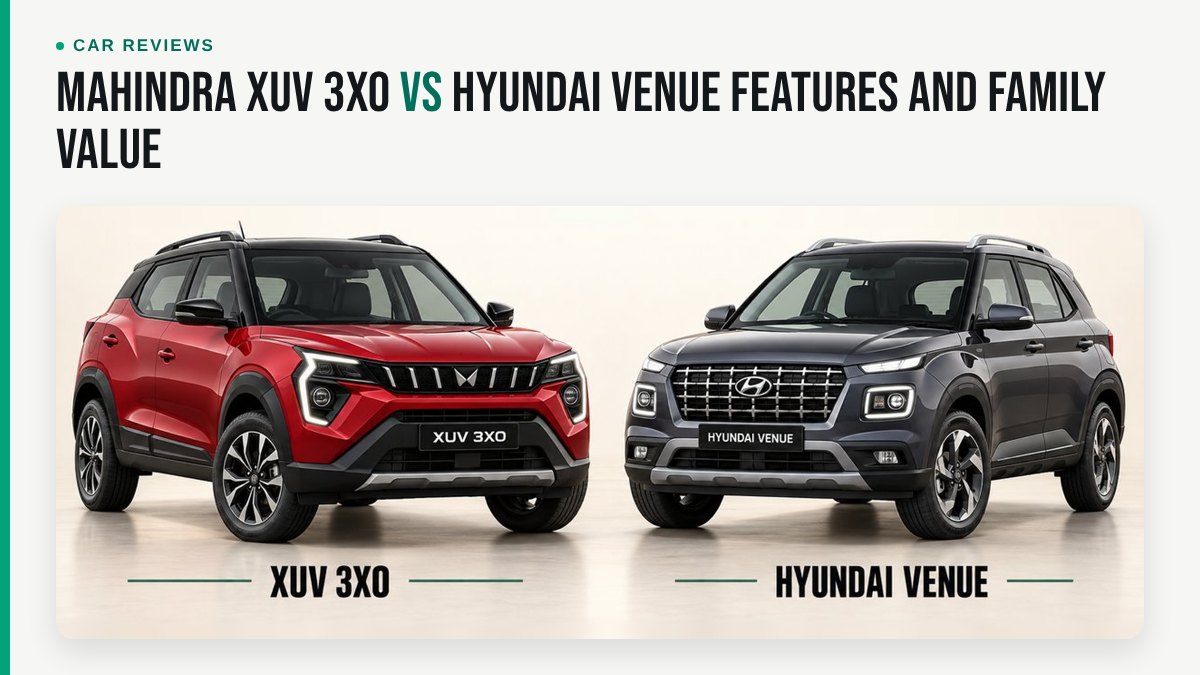
Quick answer
Compare the Mahindra XUV 3XO and Hyundai Venue by fuel and gearbox first. Both offer petrol and diesel choices, but their automatic systems differ. The 3XO has petrol automatic and diesel AutoSHIFT+ options; the current Venue offers turbo-petrol DCT and diesel six-speed automatic choices.
For a city-focused family, test the exact automatic you can afford and check rear-seat comfort with your passengers. For a manual buyer, compare the relevant engines rather than assuming the cheapest variants have equivalent performance. Current Venue information matters because old reviews may omit its diesel automatic.
Match the right versions before comparing features
The XUV 3XO range contains different petrol engine specifications, not one universal tune. Mahindra's published technical information distinguishes 1.2-litre multipoint-injection turbo petrol, 1.2-litre direct-injection turbo petrol and 1.5-litre diesel. Availability changes with trim and gearbox.
Hyundai's current Venue brochure lists 1.2-litre petrol manual, 1.0-litre turbo-petrol manual or DCT, and 1.5-litre diesel manual or automatic combinations. Compare one chosen configuration against another. A high-trim demonstration car is not evidence of the equipment or response of the entry model.
| Purchase need | XUV 3XO to inspect | Current Venue to inspect |
|---|---|---|
| Petrol manual | Confirm the turbo engine specification | 1.2 petrol or 1.0 turbo manual |
| Petrol automatic | Six-speed petrol automatic | 1.0 turbo seven-speed DCT |
| Diesel manual | 1.5 diesel manual | 1.5 diesel manual |
| Diesel without a clutch pedal | Six-speed AutoSHIFT+ | Six-speed diesel automatic |
| Higher equipment grade | Check engine and trim restrictions | Check engine and trim restrictions |
Use this as a shortlist map, then verify the exact order code. Do not let similar monthly instalments conceal different engines, gearboxes or model years.
The petrol automatic comparison is not like for like mechanically
Mahindra identifies an AISIN six-speed automatic for petrol versions. Hyundai's current Venue technical table identifies a seven-speed dual-clutch transmission with turbo petrol. Both remove the clutch pedal, but their mechanical arrangements and operating guidance are different.
Begin the test with the journeys you repeat most: moving away gently, crawling through queues and reversing into a parking place. Check accelerator and brake control. Then assess normal acceleration on a suitable road without allowing a salesperson to turn the drive into a speed demonstration.
Ask about scheduled transmission maintenance and the relevant owner's-manual instructions. Do not decide that one label guarantees perfect behaviour or that another is always unsuitable. Judge the actual version, its cost and how comfortably you can use it.
Diesel automatics need their own test drive
The 3XO's diesel AutoSHIFT+ should not be confused with its petrol automatic. An automated manual arrangement can feel different during gear changes. Test the diesel version itself if that is the one you intend to buy.
The current Venue diesel automatic is a real option, not a missing combination as some earlier comparisons suggest. Hyundai also announced an HX8 diesel automatic in March 2026. That announcement confirms the option, but its launch price should not be treated as your current on-road quotation.
Try both with the usual passenger load where possible. Check slow traffic, changes of pace and hill-start operation using the manufacturer's guidance. A short petrol demonstration cannot settle a diesel automatic decision for either brand.
Decide whether diesel suits your week
List your typical journey lengths and annual kilometres. A few long holidays do not change a week dominated by very short errands. Read the emissions-system guidance and ask the dealer how your regular usage fits the operating requirements.
Build a cost estimate using the exact diesel and petrol variants you would otherwise buy. Include the purchase-price difference, financing, fuel, insurance and scheduled maintenance. Use current local fuel prices and realistic consumption assumptions, not only certified figures.
Check applicable vehicle-use rules for the place where you expect to keep the car. Do not rely on a salesperson's broad statement that diesel always pays after a certain distance. The answer depends on your costs, ownership period and journey pattern.
Features should be compared at the same budget
A long list on a top variant says little about value if that trim is outside your budget. Write down the equipment you will use every week, then find the lowest suitable version in each range. Compare those two quotations first.
For many households, useful parking assistance, phone connectivity and easy climate controls deserve more attention than cosmetic finishes. Sit in each car and use the controls while parked. Check screen readability and whether your normal phone functions work during the demonstration.
If a sunroof or connected feature matters, verify its exact trim availability and any subscription conditions. Do not assume an advertising photograph shows standard equipment. A marked current feature matrix is more useful than a verbal promise that the booked car will be fully loaded.
Safety scores need the current model context
The Bharat NCAP 2026 Venue fact sheet records 31.15 out of 32 for adult protection and 44.46 out of 49 for child protection. It names the tested diesel versions and provides an annexure of applicable variants. Those details are part of the result, not optional small print.
Use the XUV 3XO's applicable assessment record when making a numerical comparison. Do not substitute an older XUV300 test or merge scores from different programmes. Keep adult and child results separate and confirm the coverage for the exact variant being purchased.
Crash assessments describe defined tests. They do not guarantee safety in every road incident. Check tyres, seat belts, child-seat installation and the delivered safety specification, then use the vehicle responsibly. A small difference in one score should not be presented as a complete prediction of every accident.
Check driver assistance before paying extra
ADAS equipment can vary by grade and transmission. Ask which functions are fitted to the quoted vehicle and read their limits. A camera, warning system or adaptive function should not be assumed available across the whole range.
Ask for a safe explanation of controls and alerts. Do not attempt a risky test of emergency braking on a public road. Establish how to operate and disable settings appropriately under the manual, and whether the usual driver finds the information clear.
The driver remains responsible even when assistance is active. Decide whether the additional equipment is useful enough to justify the price premium after your essential requirements are covered. Do not borrow beyond a sensible budget merely to obtain the longest technology list.
Rear seat and luggage checks can settle the shortlist
Set the front seats for their usual occupants and then seat the regular rear passengers. Check space for feet and knees, head clearance and the comfort of the middle seat if it will be used often. Try entry and exit for older family members.
Bring the child seat, pram or luggage that determines your real needs. Check belt access after the child seat is fitted. A bag that fits only with a rear seat folded does not answer a journey on which every seat is occupied.
Inspect the luggage floor and spare-wheel or repair-equipment arrangement on the exact variant. Do not compare one boot after equipment has been removed with another in normal condition. Secure luggage properly and check that the tailgate closes without forcing it.
Parking suitability is more than overall length
Driveway width, door-opening room and the turn into your building can matter more than a small length difference. Measure your parking place, including the space needed to walk around the vehicle. Consider where a wall or pillar sits beside the driver's door.
During the test drive, assess the view at junctions and the ability to judge corners. Check mirrors and the actual parking camera, if fitted. A feature cannot compensate fully for an uncomfortable driving position or poor visibility for your height.
Ask about a home demonstration if access is unusually tight and the dealer offers it. Do not commit solely from a diagram showing the vehicle inside a rectangular parking bay. The approach and exit need to work as well.
Price comparisons need matching insurance and finance
| Item | What to record |
|---|---|
| Vehicle | Trim, engine, gearbox and model year |
| On-road costs | Registration city and itemised charges |
| Insurance | Cover, insured value and deductibles |
| Loan | Down payment, rate, fees and tenure |
| Extras | Optional accessories and service packages |
| Delivery | Written date and cancellation conditions |
Compare quotes on the same date. A discount can be offset by expensive insurance, accessories or finance. Request the total repayment as well as the EMI so a longer loan does not look like a cheaper car.
Keep room for routine running costs. The affordable variant is the one that fits your whole ownership budget, not just the amount you can arrange at delivery.
Check the workshops you would actually use
Locate the practical service centre for each brand and ask about appointment availability and operating hours. Request the maintenance schedule for the chosen engine. Separate a prepaid service package from the manufacturer's warranty and confirm what each covers.
Your local access can outweigh a small equipment difference. Travel time, leave from work and the availability of support during a problem are household costs too. National reputation does not establish how convenient one particular workshop will be.
Questions about XUV 3XO and Venue
Does the Venue have a diesel automatic
Yes. The current brochure lists diesel automatic combinations and Hyundai announced an HX8 diesel automatic in March 2026. Confirm the current trim and quotation before ordering.
Are the 3XO petrol and diesel automatics the same
No. Mahindra identifies petrol automatic and diesel AutoSHIFT+ arrangements separately. Drive the intended version rather than using one to judge the other.
Which should I choose for city driving
Start with your preferred fuel and automatic requirement. Compare low-speed operation, parking visibility and family comfort, then check the on-road and ownership budget.
Can I compare old Venue safety information
Only with clear model-year context. The current 2026 Bharat NCAP fact sheet has its own tested versions and applicability annexure. An older model's record is not interchangeable.
Is the top variant always better value
No. Compare the extra price with equipment you will actually use. A lower version can be the more suitable purchase if it meets your needs without straining the budget.
Test the versions you can afford
Request matching petrol or diesel demonstrations and itemised quotes. Bring regular passengers and check your parking needs. Choose after comparing the actual gearboxes, safety specification and local service access, not just screen sizes or introductory prices.
Related reading
- Mahindra XUV 3XO variants explained
- On-road price calculation explained
- New car discount negotiation tips