



Quick answer
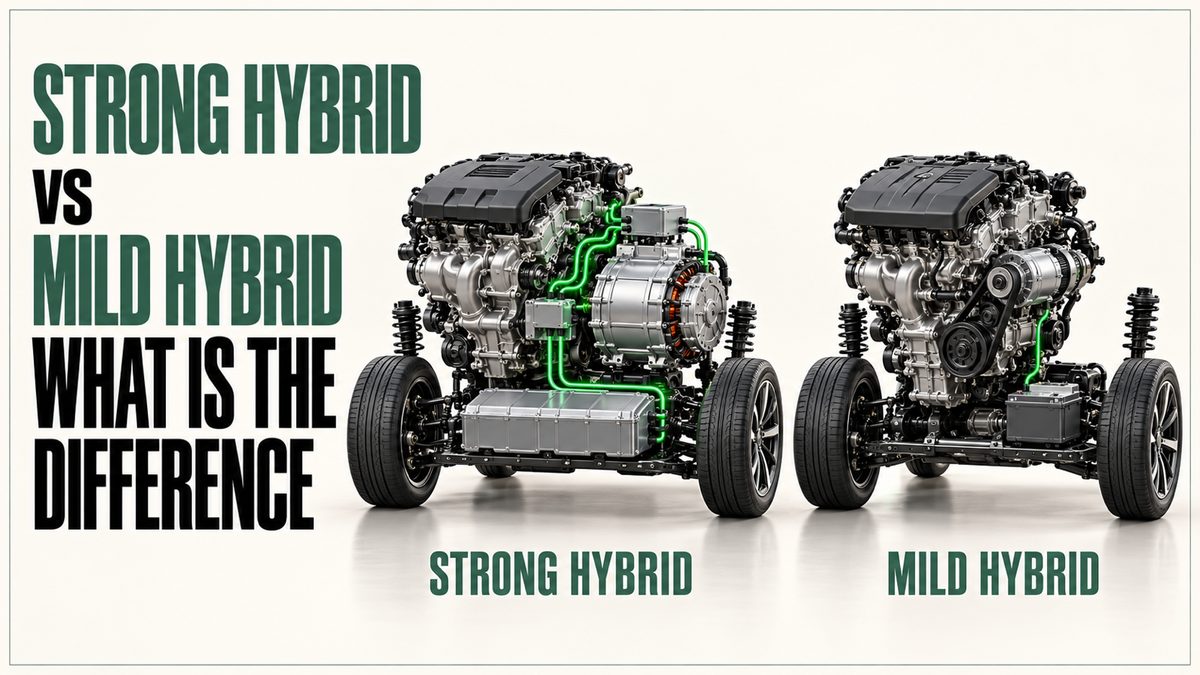
A strong hybrid has an electric drive system that can propel the car without the petrol engine running under suitable conditions. A mild hybrid mainly assists the petrol engine with functions such as restarting, energy recovery and acceleration support. It does not offer the same engine-off electric propulsion capability.
Neither label tells you the whole ownership story. Compare the exact engine, gearbox, luggage layout, purchase price and warranty. This article focuses on non-plug-in systems sold in ordinary passenger cars. A plug-in hybrid is a separate category, and a battery-electric car has no petrol engine.
The difference in one table
| Feature | Mild hybrid | Non-plug-in strong hybrid |
|---|---|---|
| Main role of electrical system | Support the combustion engine | Provide electric propulsion and work with the engine |
| Engine-off electric driving | Not the defining capability of a mild hybrid | Possible when operating conditions permit |
| External charging | Not normally required | Not required |
| Fuel purchased | Usually petrol in the examples discussed | Petrol |
| Energy recovery | System-dependent braking or deceleration recovery | Regenerative braking within operating limits |
| What buyers must verify | Actual assistance functions and gearbox | Hybrid operating modes and exact variant |
The table describes the categories rather than promising identical behaviour across brands. Manufacturers use different hardware and names. Read the model's own specification before deciding which category applies to a car described simply as a hybrid.
How a mild hybrid helps the engine
In a mild hybrid, an electrical system supports the combustion engine rather than replacing it as the normal source of propulsion. Maruti Suzuki's Smart Hybrid explanation identifies torque assistance, idle start-stop and recovery of energy during braking or deceleration. The recovered energy can support the system's later operation.
The driver may notice the engine stopping at a halt or restarting when the vehicle is ready to move. Exact operation depends on the car and conditions. Do not assume every engine stop means the car has become an electric vehicle. A stationary engine-off function and electric propulsion answer different questions.
For a buyer, the useful comparison is with the actual non-hybrid or other hybrid variant available. Check the engine, gearbox and equipment rather than paying for a label in isolation. Some functions may be familiar in ordinary cars, but the combined hardware and operation need model-specific confirmation.
How a strong hybrid moves the car
A strong hybrid uses a traction motor and battery as part of the drive system. Depending on the design and conditions, the vehicle may use electric drive, engine power or a combination. The control system manages that choice. It is not a promise that the driver can force electric-only travel for every journey.
Maruti Suzuki's strong hybrid explanation describes an engine, electric motor, lithium-ion battery and power-control unit. Honda's City e:HEV material describes automatically selected EV, hybrid and engine-drive modes. These are examples of why one general description should not be used as a detailed operating manual for every hybrid.
You still buy petrol for a non-plug-in strong hybrid. The battery stores and supplies energy during use, but the car does not create unlimited energy. When a manufacturer calls it self-charging, that distinguishes it from an externally charged vehicle; it does not remove fuel consumption.
Do either of them need a charger
The non-plug-in mild and strong hybrids discussed here do not need a home charging point. You refuel them as directed for the vehicle. Their electrical systems manage energy within their design. That can appeal to buyers who do not have a dependable parking-space charger.
A plug-in hybrid is different because it is designed to accept external electrical charging as well as use fuel. A battery-electric car relies on charging rather than a petrol engine. Ask the dealer to identify the exact category if a sales description uses the broad word hybrid without explanation.
Do not infer the category from the presence of an EV button, a blue badge or a dashboard animation. Read the powertrain specification and owner's manual. Controls can have operating limits that are not apparent from a short showroom demonstration.
When electric-only operation is available
A strong hybrid can run with the engine off in suitable conditions, but battery state, demanded power, temperature and the vehicle's operating strategy can affect availability. The engine may start even when you hoped to remain in electric drive. That need not mean there is a fault.
Avoid buying on a promise such as always electric below a fixed road speed unless the manufacturer explicitly supports it for that model and conditions. A speed figure repeated online can omit important restrictions. The current manual is a better reference than a simplified sales line.
During a normal supervised drive, watch the energy display only when it is safe and without distracting yourself. Ask the representative to explain the modes while parked first. You should assess how the car responds to normal driving, not try to defeat its controls to keep the engine off.
Why mileage claims need careful comparison
Strong hybrids can reduce petrol use in suitable operation, but the benefit depends on the route and vehicle. Short trips, congestion, climate-control demand and driving style affect consumption. A certified economy figure is a comparison reference, not a personal guarantee.
Compare the correct variants using the same measurement basis. A smaller mild-hybrid car and a larger strong-hybrid SUV differ in many ways beyond their electrical systems. A difference in published mileage cannot be attributed entirely to one technology when body size, engine and gearbox also change.
For your budget, convert a cautious consumption estimate into rupees per kilometre using the petrol price where you refuel. Then multiply by your annual distance. Repeat with a less favourable consumption estimate. If the decision changes after a small adjustment, the claimed saving should not carry the purchase on its own.
Compare the purchase premium against your use
Get an itemised on-road quotation for each exact variant. Check whether extra equipment explains part of the price difference. If one car has a different safety package or gearbox, you are buying more than a change in hybrid hardware.
Use your normal ownership period when comparing fuel spending. A household driving occasionally may recover very little of a large upfront difference through petrol savings. Someone covering longer daily distances may place more weight on operating cost, provided the selected car also suits the family.
Keep finance interest separate and use matching assumptions. A lower monthly instalment can come from a longer loan, not a lower total cost. This is a buying comparison, so there is no need to declare one technology universally better for every income or travel pattern.
The gearbox and cabin still need a test
Hybrid categories do not establish how every gearbox feels. Ask what transmission the exact model uses and read its operating instructions. Do not assume an e-CVT is mechanically identical to every transmission carrying the CVT name, or that all mild hybrids use the same automatic type.
Try ordinary acceleration, slow traffic and parking with the dealer's permission. Listen to how engine sound changes relative to road speed and decide whether you find it comfortable. A normal demonstration can answer more about your preferences than a list of technology labels.
Check the rear seat and luggage area too. Battery packaging may change space or equipment relative to another powertrain. Take the usual passengers and bags. A fuel-saving calculation is of limited value if the vehicle cannot carry what your household needs.
Battery warranty is not battery life
Ask for the warranty document for the actual hybrid system. The traction battery, auxiliary battery and general vehicle may have different cover. Confirm the time and distance limits, exclusions, maintenance obligations and conditions for transferring cover to another owner.
Warranty expiry is not a scheduled replacement date. Equally, a long warranty does not make all future repairs impossible. Avoid treating either an optimistic sales statement or an alarming online replacement bill as certain. The model's terms and a workshop's diagnosis provide a firmer basis.
For a used hybrid, request service records and an authorised inspection. A quiet engine-off demonstration does not establish battery health. Ask the workshop which checks are available for that particular system, and keep the findings with the vehicle documents.
Questions worth asking at the showroom
Ask whether the car can propel itself with the engine off, whether it accepts external charging and what gearbox it uses. Request the current brochure rather than a general brand presentation. Those answers establish the category and the vehicle you are actually comparing.
Then ask about your practical use: the correct service schedule, nearby workshop capability, boot layout and warranty. If a representative claims a fixed saving, ask for the consumption, distance and fuel-price assumptions behind it. A useful explanation should remain clear when those inputs change.
Finally, write the exact engine and variant on the quotation. Some model ranges include more than one kind of hybrid-related powertrain. A familiar model name does not ensure that the lower-priced car has the strong-hybrid system you intended to buy.
Frequently asked questions
Can a mild hybrid drive like an electric car
It does not provide the same engine-off electric propulsion capability as a strong hybrid. Check the manufacturer's description of the exact system rather than assuming electric driving from a badge.
Is a strong hybrid a plug-in hybrid
Not necessarily. The non-plug-in strong hybrids discussed here do not accept external charging. A plug-in hybrid is a distinct type with different charging arrangements.
Will a strong hybrid always use less petrol
No universal result applies across different vehicles and journeys. Compare the correct versions and use realistic consumption assumptions for your route.
Does self-charging mean free energy
No. The vehicle still needs petrol and manages energy through its engine, battery and recovery system. The term does not mean unlimited electric travel.
Which should I choose for occasional driving
Compare the full purchase difference and your low annual fuel use. Cabin fit, driving preference and total cost may matter more than a large claimed mileage advantage.
Check the powertrain before comparing the price
Identify the exact hybrid type, collect matching quotations and test the cars on a representative route. Choose the system whose cost and daily behaviour fit your use, with its operating limits understood before delivery.