



Quick answer
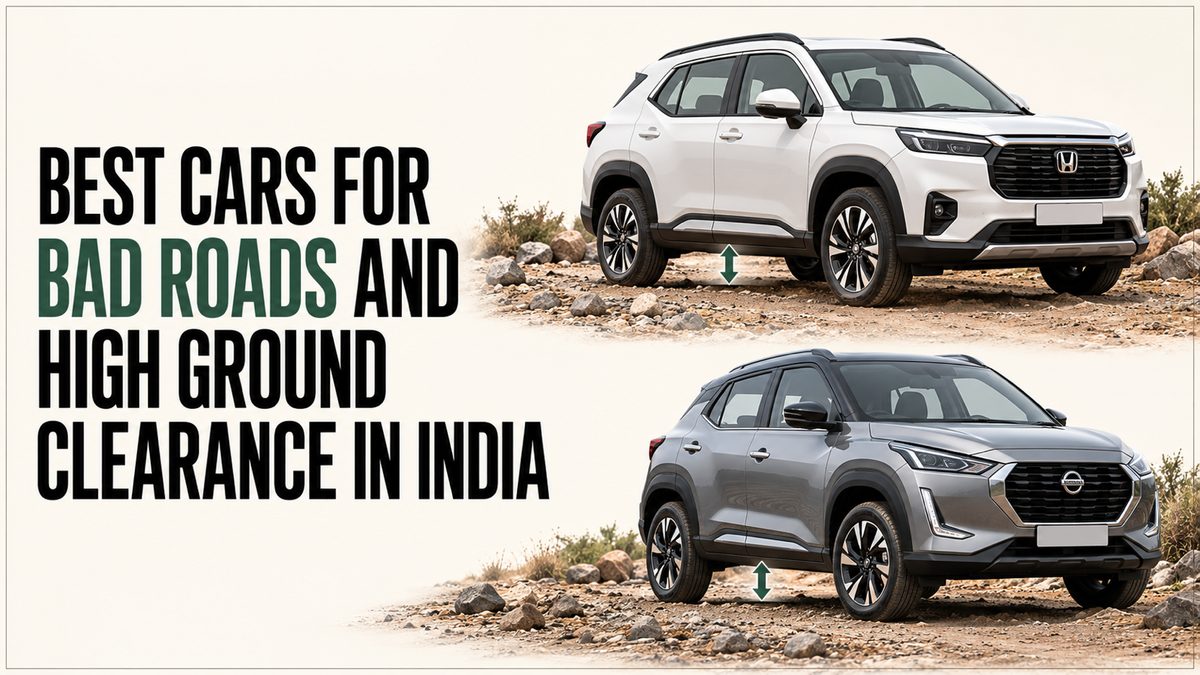
Honda Elevate, Renault Duster, Renault Kiger and Nissan Magnite are useful cars to compare when ground clearance is a priority. Manufacturer references quote 220 mm for Elevate, 212 mm for Duster and 205 mm for both Kiger and Magnite. Confirm the measurement basis and current version before comparing the figures directly.
The best car for bad roads also needs suitable ride comfort, tyres, visibility and manageable dimensions. Clearance alone does not establish that a vehicle can cross a particular obstacle, drive through a flood or handle off-road terrain. Test the car on an ordinary route similar to yours, with a realistic passenger load and the dealer's permission.
Published clearance references
| Model | Manufacturer clearance reference | Source context |
|---|---|---|
| Honda Elevate | 220 mm | Honda brochure and model information |
| Renault Duster | 212 mm | Current design page and configurator |
| Renault Kiger | 205 mm | Current model page and configurator |
| Nissan Magnite | 205 mm | CarJade model listing, unladen |
These are published specifications rather than independent measurements. Load, tyre specification and the manufacturer's measurement method matter. Ask whether the quoted figure is loaded or unladen and whether it applies to your chosen variant. A difference of a few millimetres should not replace a practical assessment of the whole vehicle.
Honda Elevate
Honda's Elevate brochure quotes 220 mm clearance, identified as internal manufacturer data. Its model information also describes a 1.5-litre petrol engine with manual and CVT choices. Use the current brochure and variant sheet to confirm the exact specification of the car being offered.
The Elevate is worth comparing if you want a taller crossover alongside a compact SUV. Check its overall size against your parking space and the width of your usual lanes. A useful clearance figure can coexist with a body that needs more room at home than your present car.
Take rear passengers on a normal drive over imperfect surfaces. Ask them about the movement they feel rather than relying on the driver's impression alone. Keep speed appropriate and do not seek out dangerous potholes to test the car. Normal road imperfections are enough to reveal whether the ride suits your family.
Renault Duster
Renault's current Duster design page and configurator quote 212 mm clearance. The configurator identifies a five-seat, two-wheel-drive example, which is a reminder to verify the drivetrain rather than inferring it from the SUV name. Other specifications should be checked for the chosen version.
Compare the Duster if your routes justify a larger vehicle and you can accommodate it comfortably. Check the view of road edges, the ease of placing the front wheels and how clearly you can judge the car's width. These everyday observations can matter on narrow, damaged streets.
Ask for the current engine and gearbox specification on the quotation. Do not transfer assumptions from an earlier generation to a new model. A familiar name may cover a different vehicle, so check the present owner's manual for load limits, maintenance and permitted use.
Renault Kiger
Renault lists 205 mm clearance for the Kiger on its model page and configurator. The current specification display shows a five-seat arrangement and a 2,500 mm wheelbase. The model offers more than one engine and transmission, so confirm which demonstration car you are driving.
It is a useful compact comparison when the route includes both crowded urban areas and uneven roads. Check whether the seat and steering position let you judge the near side without leaning awkwardly. Also try the turning and parking manoeuvres you repeat most often.
A compact size and clearance number should be considered together with the suspension feel. Drive at a sensible speed over ordinary surface changes and listen for unusual knocks. A showroom vehicle with incorrect tyre pressure can give a misleading impression, so ask the representative to check the manufacturer's recommended setting.
Nissan Magnite
CarJade's Magnite listing shows 205 mm clearance, unladen. Check the figure against the official Nissan brochure for your trim before relying on it. Check the specific trim's tyres and transmission because the range includes different drivetrain choices and equipment levels.
The Magnite gives buyers another compact vehicle to compare on the same route as the Kiger. Use a consistent passenger load and similar conditions. Record the ride, low-speed control and visibility separately rather than deciding from one particularly smooth or rough patch.
For an automatic, assess gentle movement on an incline and reversing into your parking area. Ask how to operate the chosen gearbox according to the manual. A CVT and AMT can feel different in these situations, so compare the actual version rather than assuming every automatic behaves alike.
Why high clearance does not settle every ramp problem
A vehicle can touch a steep ramp near its bumper or underneath between the axles. The length of its overhangs and the shape of the ramp affect the result. A published clearance figure cannot describe every point on the body or every approach to an obstacle.
If a particular basement entry causes trouble, request a supervised home demonstration where practical. Use the intended normal passenger arrangement and a safe approach. Do not attempt an angle that risks other vehicles, pedestrians or property simply to prove a point.
Record where your current car scrapes and show the location to the dealer. That gives a more useful question than asking whether a new model is generally good for Indian roads. If the obstacle cannot be crossed safely, changing the route or parking arrangement may be necessary.
Ride comfort needs passengers and a familiar route
Arrange a route with ordinary patches, speed breakers and turns you recognise. Use a safe speed rather than comparing how quickly the cars can cross defects. Ask passengers in both rows to describe the movement and whether it settles comfortably after the surface changes.
Check seat support as well as suspension feel. A comfortable seat can make a difference during a longer journey, while a seating position that strains the driver will remain tiring on smooth roads too. Adjust the seat properly before starting the comparison.
If the dealer permits only a short route, note that limit in your decision. Avoid treating a brief demonstration as proof of comfort over every road. Try another appointment with the correct engine, gearbox and wheel specification if the first car does not match your intended order.
Tyres and load change the everyday experience
Use the tyre pressures recommended for your vehicle and load. Do not reduce or raise them beyond the guidance simply to change the ride or clearance. The correct settings support the tyre's intended operation and should be checked as directed in the manual.
Inspect the tyre and wheel specification on the quoted trim. A larger wheel appearance is not enough reason to assume better comfort over broken surfaces. Ask about replacement availability and cost if your driving regularly takes you far from a major city.
Passengers and luggage also matter. Stay within the manufacturer's load limits and secure bags properly. Do not judge a fully occupied family journey from an empty demonstration car or expect the advertised clearance to remain unchanged under every load.
Water depth is a separate question
Do not use clearance as a flood-crossing rating. Water can hide road damage, moving currents and obstacles, while a vehicle's air intake and electrical components introduce other limits. If the route is flooded and conditions are uncertain, choose another route rather than assuming an SUV can continue.
Hyundai's current Exter manual advises avoiding flooded areas unless its stated conditions are satisfied and notes that braking performance can be reduced after water exposure. Follow the instructions for your own car. A passage from another model's manual does not establish your vehicle's permitted depth.
If the vehicle stalls or shows a fault after water exposure, seek the manufacturer's recovery guidance rather than repeatedly trying to continue. Discuss the circumstances with the authorised workshop and insurer where relevant. The purchase decision should never rely on an unverified claim of flood protection.
Maintenance for repeated rough-road use
Read the service guidance for severe use if your route is frequently dusty, damaged or unpaved. Ask the workshop whether your conditions require different inspections or intervals. Keep service records, especially after a substantial impact or a change in steering feel.
After a hard pothole impact, inspect safely for visible tyre damage or unusual behaviour and arrange a professional check when needed. Persistent vibration, pulling or new noises deserve attention. Do not dismiss them because the vehicle has a high clearance specification.
Avoid unapproved suspension lifts or tyre-size changes as an easy fix for scraping. Ask the manufacturer how any proposed change affects handling, load limits and warranty. A car that fits the route in its approved specification is a better starting point for a normal purchase.
Frequently asked questions
Is the highest-clearance car automatically the best choice?
No. Passenger comfort, tyres, visibility, dimensions and load requirements also matter. Compare the whole vehicle on a suitable route.
Does 205 mm clearance mean safe flood crossing?
No. Clearance is not a water-wading rating. Follow the exact vehicle manual and avoid uncertain flooded routes.
Will a short wheelbase always prevent scraping?
No. Bumpers, overhangs, ramp shape and load also affect contact. A safe practical check is more useful than one measurement.
Should I change tyre pressure to improve the ride?
Use the manufacturer's recommended pressures for the vehicle and load. Do not improvise a setting from a general online suggestion.
How should I choose between two similar SUVs?
Drive the intended variants on the same ordinary route with similar passengers, then compare ride, control, parking fit and ownership costs.
Test the route that matters to you
Choose two candidates, ask for a supervised comparison on representative roads and check the exact variant documents. Buy the car that suits your family and route as a whole, with the clearance figure serving as one part of the decision.