



Quick answer
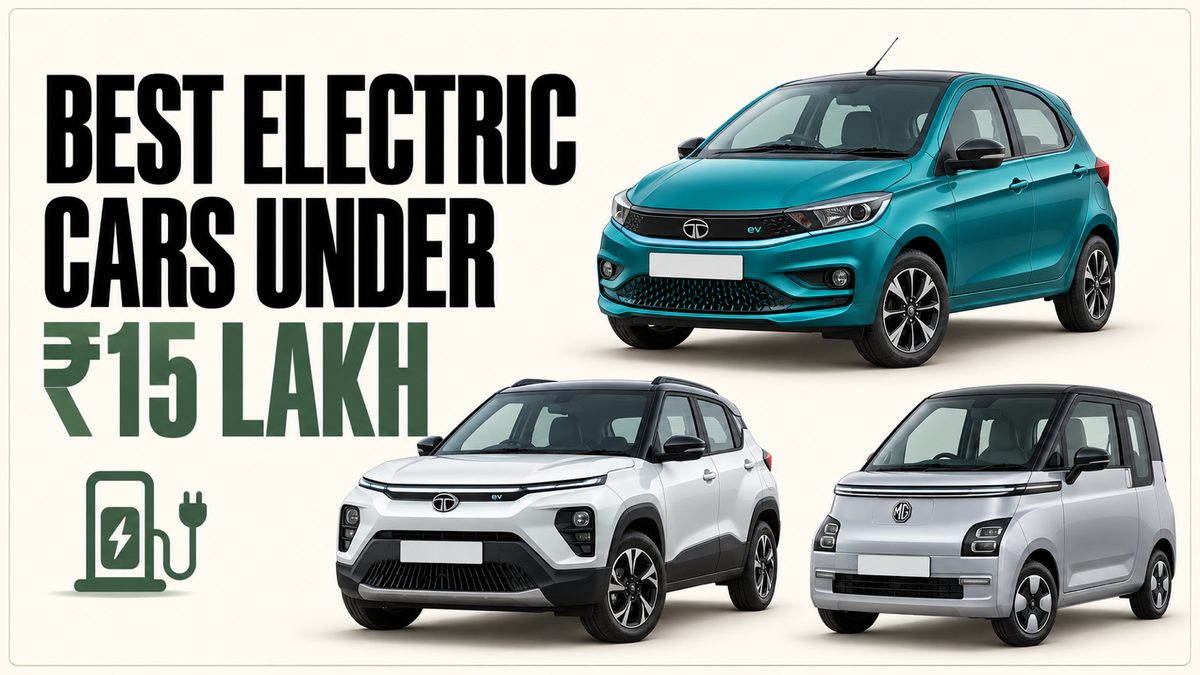
Tata Tiago.ev, Tata Punch.ev, selected Tata Nexon.ev variants and MG Comet EV are useful models to investigate below ₹15 lakh ex-showroom. Start with your seating and charging needs, then verify the current exact-variant quotation. A low price with a separate battery charge is not equivalent to a battery-inclusive purchase price.
If ₹15 lakh is your total on-road limit, leave room for insurance, applicable charges and charging installation. This shortlist uses manufacturer price references, with their dates and conditions stated. It does not promise that every trim or every city quotation falls within the budget.
Price references and the conditions behind them
| Model | Manufacturer price evidence | What to verify before buying |
|---|---|---|
| Tata Tiago.ev | ₹7.99 lakh starting figure in Tata's 2025 announcement | Current variant price and battery specification |
| Tata Punch.ev | Current price page lists ₹9.69–12.59 lakh ex-showroom | Exact battery, trim and charger arrangement |
| Tata Nexon.ev | Current price page starts at ₹12.49 lakh for Creative Plus MR | Which selected versions remain below ₹15 lakh |
| MG Comet EV | MG's EV listing gives ₹7.49 lakh starting figure | Battery-inclusive quote versus separate battery payment |
These are not on-road quotations. The Tiago figure is a dated manufacturer announcement rather than a verified October 2026 dealer price. Obtain a fresh written amount for all four cars. Offers, equipment and ownership plans can change without making an older reference false for its original date.
Tata Tiago.ev for a hatchback-shaped starting point
Tata's 2025 model announcement includes the Tiago.ev with a ₹7.99 lakh starting figure. That supports its place on an affordable-EV enquiry list, but the current battery and trim need confirmation. Do not assume the entry car has the same range or features as a higher-priced display vehicle.
Compare it if a hatchback suits your daily parking and family arrangement. Sit in the rear with the driver's seat set normally and take your usual bags. A modest purchase price is useful only when the car can handle the journeys and passengers you actually have.
Ask about charging capability for the specific version. Your home supply, approved installation and available charging hours should work together. Do not infer fast-charging capability or equipment inclusion from another Tata model or a higher Tiago.ev trim.
Tata Punch.ev for a compact crossover option
Tata's current Punch.ev price page lists a ₹9.69–12.59 lakh ex-showroom range across 30 kWh and 40 kWh batteries and named trim groups. The June 2026 announcement also separates the regular starting price from a lower upfront battery-financing alternative. Keep those ownership arrangements distinct.
The Punch.ev is worth inspecting when you want a compact crossover layout rather than choosing only on a battery-size number. Check entry, rear seating, luggage and parking visibility. The family should try the quoted version, especially if the equipment changes across trims.
Compare the two battery choices against the actual route and charging access. A larger battery can add purchase cost that may or may not be necessary for your routine. Do not pay more solely for a range claim without considering how often the extra distance would be useful.
Tata Nexon.ev for selected versions within budget
Tata's current Nexon.ev price page gives ₹12.49 lakh ex-showroom for the Creative Plus MR with a 30 kWh battery. It also lists higher-priced versions beyond this article's limit. Therefore Nexon.ev belongs here as a selected-variant option, not as a claim that the entire range costs under ₹15 lakh.
Start by requesting the exact qualifying versions. Ask how their battery, charging and equipment differ from the model used for a test drive. A demonstration in a larger-battery car can help assess seating, but it cannot establish the smaller version's range.
Keep the full budget visible. If insurance and other charges take a preferred version above your on-road limit, compare a lower trim or another model. An advertised ex-showroom fit should not quietly become a higher total than you intended to spend.
MG Comet EV for a city-focused household
MG describes the Comet as a two-door, four-seat electric car. Its model page identifies a 17.4 kWh battery and a published 230 km range claim. Treat that as a manufacturer reference rather than a guaranteed journey distance. Its compact layout makes passenger access an important personal check.
Ask every regular rear passenger to try entry and exit. Check the space for bags with the required seats occupied. A city car used mainly by one or two people can answer a different need from a household's only vehicle used for full-family trips.
MG's current website also displays a lower upfront Comet price with a separate per-kilometre battery amount. Do not compare that headline directly with a battery-inclusive car. Request both complete ownership proposals and read the recurring-payment conditions before deciding which is affordable.
Home charging is a buying requirement to resolve early
Check whether you have a suitable, permitted place to charge. Ask the vehicle supplier or qualified installer to assess the electrical arrangement. Apartment approval, cable routing and parking access should be settled before the booking becomes a commitment.
Do not plan around an ordinary socket without confirming that the vehicle's approved charging equipment and installation requirements can be met safely. Avoid improvised extension leads or electrical modifications. The aim is a dependable everyday arrangement, not a temporary setup that becomes permanent by accident.
Ask what installation is included, what is extra and who supports a fault. Keep those amounts in the purchase budget. A lower car price may not be the cheaper usable package if a substantial charging setup is still needed.
Public charging needs a realistic backup plan
Identify suitable chargers near the routes you use, checking connector compatibility and the car's charging capability. A high number printed on the charger does not mean your car will accept that power. The vehicle and conditions can limit the actual rate.
Check payment arrangements, access hours and a second location. Do not assume every mapped charger is available when you arrive. A backup is especially important if public charging would be your main routine rather than occasional support.
For intercity use, plan stops using a cautious range estimate with a reserve. A published certification figure should not be treated as the distance you must cover before charging. Weather, speed, load and the route can change consumption.
Compare ownership plans on the same basis
Ask whether the battery is included in the quoted purchase amount, financed separately or paid for under another plan. Read any minimum-distance, monthly-payment, tax and exit conditions. The headline amount alone cannot establish the total commitment.
Calculate several annual-distance cases if payments depend on kilometres. Keep charging electricity separate from battery payments unless the contract explicitly combines them. A per-kilometre battery amount is not automatically the complete driving cost.
If comparing a loan with a battery plan, use matching ownership periods and be clear about what you own at the end. Ask what happens when selling the vehicle. Avoid making a choice based only on the smallest first payment or an advertisement's monthly figure.
Range and battery warranty need precise wording
Read the range figure's test basis and ask for the current battery-cover document. Time, distance, ownership transfer and exclusions can matter. A general claim of long cover does not establish identical terms for every battery and owner.
Do not confuse a stated battery warranty with an unrestricted promise about usable range throughout ownership. Ask how a complaint is assessed and what maintenance records are required. Keep the actual terms rather than a screenshot of a promotional banner.
For a used EV, request an appropriate inspection and service history. A full charge on the display does not, by itself, establish the condition or usable capacity of the battery. Match the purchase price to a vehicle you have checked, not only its original list price.
A useful test drive under this budget
Try normal traffic, parking and an ordinary stretch of your usual route. Compare visibility, seat comfort and how the controls respond. Ask for the demonstration car's exact battery and trim so that any mismatch with the quotation is clear.
Bring your normal passengers and luggage if the car will be the household's main vehicle. Check the rear seat after adjusting the driver's position. Do not accept a fit that works only when someone sits unusually or a required seat is folded.
Finally, compare the itemised total. Keep optional accessories apart from required equipment and read the insurance basis. The best affordable EV is one you can purchase, charge and use without a hidden change in the budget or routine.
Frequently asked questions
Which EV should I inspect first under ₹15 lakh
Choose by use. Compare Tiago.ev for a hatchback, Punch.ev for a compact crossover, selected Nexon.ev versions for another family option, and Comet for a city-focused four-seat layout.
Does a low battery-rental price include the battery outright
Do not assume it does. Read the full ownership proposal and separate the upfront amount, recurring battery payments and charging electricity.
Is ₹15 lakh ex-showroom the same as on road
No. Insurance, applicable charges and charging arrangements can add to the amount. Obtain a city-specific quotation for your total limit.
Will the brochure range cover every trip
Not necessarily. Use a cautious route estimate with a charging reserve rather than planning to exhaust the published distance.
Should I book before arranging home charging
Resolve the charging position first where home charging is part of your plan. Confirm permissions, installation requirements and cost before committing.
Compare the car and charging package together
Shortlist two models that fit your household, verify their exact current prices and arrange the charging assessment. Choose only after the full ownership plan, family fit and everyday charging routine are clear.