



Quick answer
EV charging time depends on how much energy you need to add and the power the car actually receives. AC charging usually takes longer and suits planned parking periods. DC charging can add energy faster when the vehicle supports it, but the rate changes during the session. A charger's advertised maximum is not a guaranteed rate for your car.
For a rough calculation, divide the energy to add in kWh by average charging power in kW. Then allow for losses and changing conditions. Always compare the same percentage window: a quoted 20-to-80-per-cent time is not a full zero-to-100-per-cent charging time.
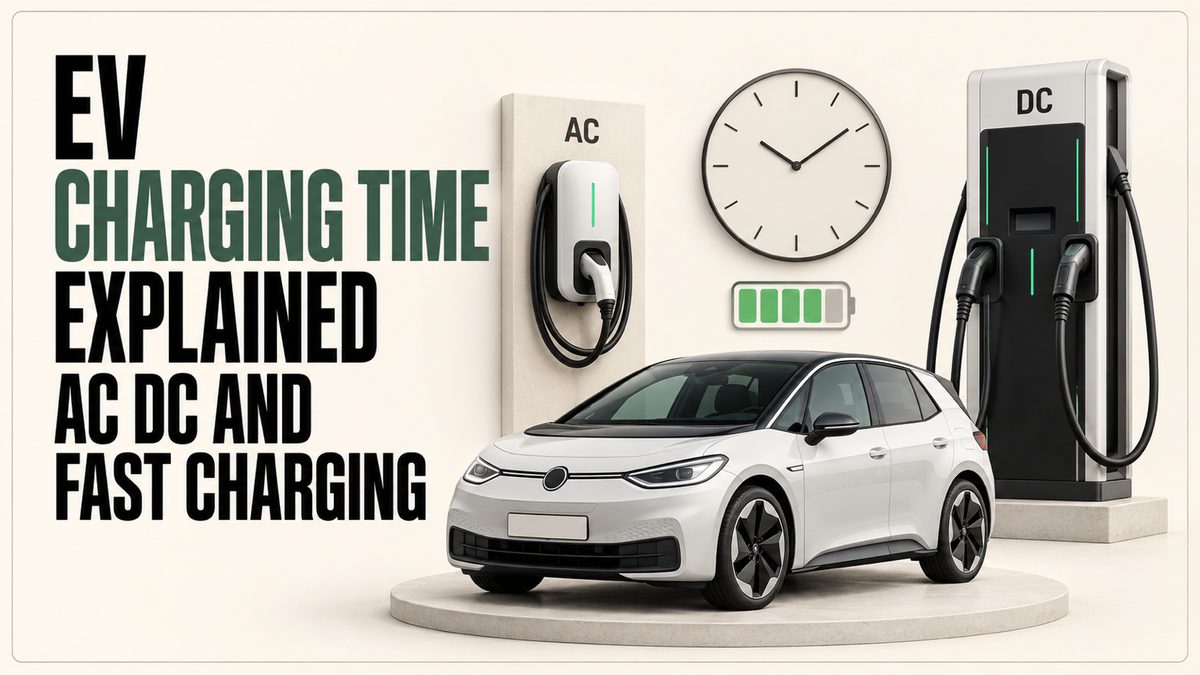
AC and DC charging do different jobs
With AC charging, the car's onboard charger converts the supplied electricity for the battery. The onboard equipment and electrical supply can limit the rate. A more powerful wall unit does not automatically make a car accept more AC power than its specification permits.
With DC charging, conversion takes place in the charging station and suitable power is delivered to the vehicle's battery system. The car must support that connection and rate. Tata Power's explanation separates these two arrangements, which is why the word fast alone is not enough to identify the charging method.
Check the exact variant's capability. A model range can contain different batteries or charging equipment. Do not use a higher trim's demonstration time as the expected result for a lower version without confirming that the specification matches.
Read a charging claim in full
Part of the claimWhat it tells youQuestion to askStarting percentageBattery level before chargingDoes this match my likely arrival levelEnding percentageTarget level used for the claimIs it 80 per cent or a full chargeCharger ratingEquipment used in the reference testCan my car accept that powerConditionsTemperature and other test assumptionsAre they stated in the footnoteBattery versionVehicle testedIs it the version on my quotationTime quotedDuration for that defined sessionDoes it include connection and waiting
Compare the complete statement rather than one large number in an advertisement. A short time for a small percentage increase is not directly comparable with a longer time covering much more energy.
The basic calculation with a clear example
Suppose a hypothetical car has 40 kWh of usable battery energy and you want to charge from 20 to 80 per cent. The difference is 60 percentage points, so the stored energy increase is about 24 kWh. This example uses an assumed usable capacity, not the advertised pack size of a named model.
If average power into stored energy were a constant 6 kW, 24 divided by six gives four hours. At a constant average of 30 kW, it gives 0.8 hours, or 48 minutes. These are arithmetic illustrations, not promises for an actual AC or DC session.
Real charging involves conversion losses and a rate that may not remain constant. Energy recorded at the charger can therefore differ from the increase stored in the battery. Use the calculation to understand the relationship, then rely on the manufacturer's stated conditions and the vehicle's session estimate for planning.
Why peak power is not average power
An EV may accept its highest charging rate only during part of a session. Battery state and temperature can influence what the system permits. Tata's charging-support guidance identifies state of charge, charger capacity and battery or charger temperature as factors affecting duration.
That means a 100 kW station label does not establish a constant 100 kW average. Your car may accept less, and the session can change as the battery fills. Calculating the whole charge using the highest number can produce an unrealistically short result.
Look at both the estimated finish time and delivered energy where the equipment provides them. A changing display is not automatically evidence of a faulty charger. If the session fails or a warning appears, use the operator's and vehicle manufacturer's support instructions rather than repeatedly forcing a restart.
Why the final part can take longer
Charging near the upper end of the battery's permitted range can take longer per percentage point than earlier in the session. The vehicle manages the rate. The practical consequence is that a stop to add enough energy for the next leg may be much shorter than waiting for a full charge.
Do not turn that observation into a universal rule to stop every car at exactly 80 per cent. Daily charging guidance depends on the battery and manufacturer. Some vehicles have specific full-charge or balancing instructions. Follow the correct manual rather than copying an owner's routine from another model.
On a trip, choose a target that covers the next leg and a suitable reserve. If the route requires more energy, charge accordingly. Saving a few minutes is not a reason to leave without enough for the planned journey and a backup stop.
Home charging is often about available parking time
Before buying, estimate how much energy your daily driving uses and how long the car stays parked at home. A vehicle does not need a full empty-to-full charge every night if only part of its energy was used. The useful question is whether the approved setup can replace your normal daily use.
Have a qualified installer assess the electrical supply, protection, parking position and permissions. Do not assume any socket or extension lead is suitable. The safe installation requirements come before a promised charging time.
Ask what equipment is included with the vehicle and what installation costs extra. Keep the assessment in writing. A more expensive charger is useful only if the car and supply can use its capability and it solves a real timing problem for the household.
Public charging adds access and waiting time
The time connected to the charger is only one part of a stop. You may need to leave the route, find the unit, start a payment session or wait for another vehicle. A brochure's charging figure does not include every one of those practical delays.
Check a compatible station and a backup before a longer journey. Confirm access hours, connector and the operator's payment method. Do not assume a location is usable just because a map contains a charging icon.
Allow enough margin when travelling with children or a fixed appointment. A plan that works only if the first unit is free, the session reaches peak power and traffic stays light is fragile. A modest buffer makes the trip less dependent on everything going exactly as expected.
Temperature affects the session
Battery and charger temperature can influence charging power. A session after different driving or weather conditions may not repeat the previous time. This is one reason an owner's single stop cannot establish the expected result for every season.
Use any battery-preparation function only as the vehicle manufacturer instructs. Not every EV has the same controls or automatic behaviour. Avoid importing a procedure from an overseas video without checking that the Indian model supports it.
If charging is unusually slow, check the vehicle and charger messages and the operator's support information. Do not assume the battery has failed from one session. Persistent problems need diagnosis, with the session details recorded so the workshop or operator can investigate.
Distinguish kW from kWh
kW describes power, or the rate of energy transfer. kWh describes an amount of energy. A 40 kWh battery and a 40 kW charger do not represent the same thing, even though the numbers look similar.
This distinction helps when checking a bill. A price per kWh concerns energy supplied, while a charge per minute or another session fee follows a different basis. Read the operator's displayed tariff rather than assuming every unit bills in the same way.
It also helps with charger shopping. More rated kW does not necessarily mean more useful energy overnight if the vehicle's onboard charger or supply is the limiting factor. Match the equipment to the actual car and installation.
What to record from a useful charging test
Write down the car and battery version, arrival percentage, target percentage, station identity, displayed power and duration. Note whether the session started normally and whether a warning appeared. Keep the receipt showing energy and the billed amount.
Use the record to answer a practical question, such as whether your regular stop fits a lunch break. Do not generalise one successful or unsuccessful session into a claim about every charger or every vehicle of that brand.
When comparing two EVs, use the same target journey and a clearly stated charge window. A larger battery can need more energy even if it charges at a higher rate. The relevant outcome is how the car supports your route, not which dashboard briefly shows the largest power number.
Frequently asked questions
How do I estimate EV charging time
Divide energy to add by average charging power, then allow for losses and changing conditions. Use the actual charge window and the correct battery specification.
Will a higher-rated charger always charge faster
No. The car's acceptance, onboard equipment, supply and conditions can limit the rate. Check the vehicle specification as well as the station label.
Does 20 to 80 per cent mean a full charge
No. It covers a 60-percentage-point increase. A zero-to-100-per-cent session includes a different energy amount and charging behaviour.
Should every EV stop charging at 80 per cent
Follow the particular manufacturer's charging guidance. Do not apply one fixed daily target to all battery types and models.
What if charging is slower than last time
Check the charge window, conditions and displayed messages. Record the session and contact support if there is a fault or a persistent unexplained issue.
Check your actual charging routine
Ask the dealer for the exact variant's AC and DC specifications, arrange the home assessment and identify a public backup. Compare charging time using your normal daily energy needs rather than an empty-to-full headline alone.