



Quick answer
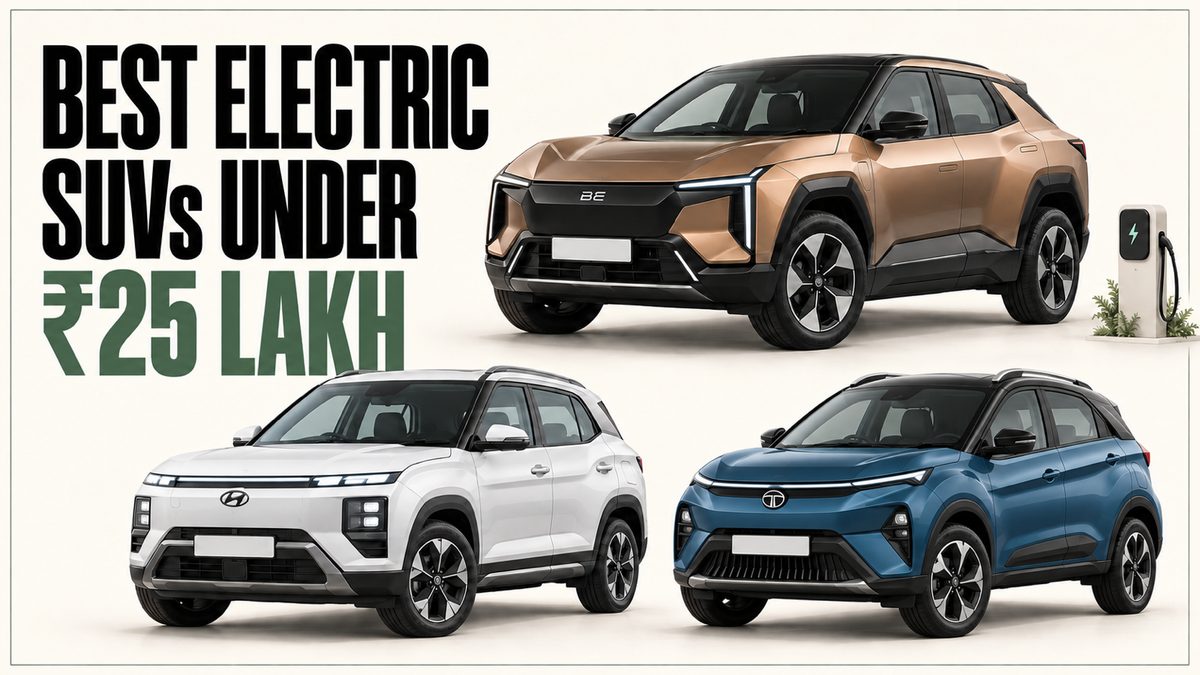
Selected Mahindra BE 6 SPORTEQ variants, Hyundai Creta Electric, MG ZS EV and Tata Nexon.ev are useful electric SUVs to compare below ₹25 lakh ex-showroom. Choose the exact battery and trim first. Some versions, chargers or ownership plans change the total, and a ₹25 lakh on-road budget is tighter than the same ex-showroom limit.
The strongest shortlist is the one that fits your passengers, parking and charging access. A bigger battery or a longer feature list does not automatically make an SUV the better purchase. Use the manufacturer price references below as a starting point, then obtain current itemised quotations.
Manufacturer price references
| Model | Published reference | Budget qualification |
|---|---|---|
| Mahindra BE 6 SPORTEQ | August 2026 table starts at ₹19.45 lakh for ONE 59 kWh | Selected versions below ₹25 lakh; charger terms need checking |
| Hyundai Creta Electric | Current Hyundai test-drive page starts at ₹17.99 lakh | Exact battery and trim must be quoted |
| MG ZS EV | Manufacturer variant page lists Executive at ₹17.99 lakh | Separate battery-payment offers are not equivalent |
| Tata Nexon.ev | Current price page starts at ₹12.49 lakh | Lower-priced SUV alternative; choose the correct battery |
These are ex-showroom references, not final city bills. BE 6 SPORTEQ prices come from the dated introduction table. Check current availability and any revision. Do not compare a chassis or battery-plan headline with another vehicle's battery-inclusive price.
Mahindra BE 6 SPORTEQ for a broader battery and trim choice
Mahindra's August 2026 announcement lists the SPORTEQ ONE 59 kWh at ₹19.45 lakh and TWO 59 kWh at ₹20.95 lakh. It lists THREE+ 79 kWh at ₹24.95 lakh, just below this article's ex-showroom ceiling. Higher versions exceed it. A lower ₹11.45 lakh BaaS headline has a separate battery payment and must not be treated as the same purchase.
Ask which variant you can actually order and what the quotation includes for charging. At ₹24.95 lakh, a version may fit the headline limit but exceed a ₹25 lakh on-road budget once other amounts are added. Keep those two limits distinct from the first enquiry.
Try the seating, controls and luggage area with the family. Do not choose a higher battery solely because it is available. Assess whether its extra capacity answers a real journey need and whether the charging arrangement supports that use.
Hyundai Creta Electric for a familiar SUV layout
Hyundai's current Creta Electric test-drive page gives a ₹17.99 lakh starting figure. That establishes a relevant enquiry point within the budget, not the price of every battery and trim. Ask for the current variant table and identify the actual version used for the demonstration.
Compare passenger entry, the driver's normal seating position and rear-seat comfort. If you know the petrol or diesel Creta, do not assume every specification transfers to the electric model. Check its own equipment, battery and luggage information.
Include an ordinary parking exercise and the routes you use most. A vehicle that feels familiar in size still needs a personal comparison. Ask the representative to explain charging and warning displays while stationary so the test drive can focus on normal vehicle control.
MG ZS EV for another family SUV comparison
MG's manufacturer variant page lists the ZS EV Executive at ₹17.99 lakh and describes a 50.3 kWh battery with a published 461 km range claim. That range is a manufacturer reference, not a guaranteed distance before every charging stop. Check the correct trim's equipment and current purchase amount.
MG also advertises ownership arrangements with a separate battery-related payment. Ask whether your quotation is battery-inclusive and request the terms if it is not. A lower initial amount may involve an ongoing commitment that belongs in the comparison.
Try the rear seats and normal luggage load before deciding. Compare the workshop and charging support you would use locally. General brand coverage is less useful than knowing where your own car would be inspected if a charging or vehicle warning appears.
Tata Nexon.ev when spending less is sensible
Tata's current price page starts the Nexon.ev at ₹12.49 lakh for Creative Plus MR with a 30 kWh battery and lists other battery and trim choices. It belongs on this list because a ₹25 lakh ceiling does not require spending the whole amount. A smaller or lower-priced option may cover the household's needs.
Ask which battery suits your normal route and occasional longer journeys. A test drive in one version does not establish another battery's range. Keep the quotation and demonstration specification together so that the comparison stays clear.
Use the money difference honestly. It might leave room for charging installation or simply reduce the purchase commitment. Do not add optional equipment merely because the budget permits it. First establish whether the car's seating, bags and charging routine already do the job.
Decide whether ₹25 lakh means ex showroom or on road
Write the total limit before visiting dealers. Include insurance, applicable local charges, charger equipment and installation. Ask which items are mandatory and which are optional. A quotation should not depend on adding an accessory package you did not request.
If a version sits very close to the ceiling, calculate the complete amount before becoming attached to it. A smaller battery or lower trim may be a sensible choice if it retains the functions you actually need. Compare alternatives without assuming the most expensive version is the only useful one.
Read finance proposals using the same ownership period and loan assumptions. A low monthly amount can hide a longer commitment or a separate battery plan. The full purchase and recurring costs should remain visible together.
Compare charging capability rather than one peak number
Ask for the exact variant's AC and DC charging information, compatible connectors and the conditions behind quoted times. A charging time normally refers to a stated starting and ending percentage. It should not be read as a promise for a full charge from any starting point.
Your home electrical arrangement can matter more than a headline public-charger speed. Have the approved installer assess supply, parking access and permissions. Do not use improvised cables or electrical changes to make a demonstration setup work at home.
For public charging, identify compatible locations on the actual travel route and a backup. Check access and payment arrangements. The presence of a charger on a map does not establish that it will be free and working when you arrive.
Use a cautious range plan for longer journeys
Published range figures use stated test methods. Weather, road speed, passenger load and the route can change consumption. Do not plan a family journey around reaching the final kilometre of the brochure claim. Leave a sensible charging reserve and an alternative stop.
Compare the cars against your longest ordinary journey, not an unlikely once-in-a-decade trip. A larger battery may add convenience, but it also adds purchase cost. Decide how often the extra capacity would avoid a meaningful interruption.
Ask about the vehicle's route and charging information tools, but keep attention on driving. Set up destinations before moving and stop safely if a change is needed. A useful feature should support the journey without becoming another source of distraction.
Family fit comes before screens and acceleration claims
Adjust the driver's seat, then put the usual passengers behind it. Check entry, visibility, seat-belt access and luggage space with all required seats available. A showroom car with an empty rear row can conceal the compromise that matters on every family trip.
Measure the parking entry and door-opening space as well as the bay. An SUV may fit the painted rectangle but remain awkward to enter or unload. Request a supervised home demonstration where available if the access is difficult to judge.
On the drive, compare normal response and gentle parking rather than dramatic acceleration. Ask each regular driver to try the controls where the dealer permits. The best everyday car should feel manageable to the person who uses it most.
Battery cover needs the actual terms
Read the battery and vehicle warranty separately. Ask about time, distance, transfer to a later owner and the maintenance record required. Do not assume a promotional phrase gives identical cover to every owner, trim or future use.
Check how a battery complaint is assessed and where diagnosis is performed. A warranty is not a fixed battery replacement date, nor does it guarantee the same usable range under every condition. Keep the booklet and quotation with the order.
For a used or demonstrator EV, establish the first delivery date and the applicable cover. Request service and repair records and an inspection appropriate to the model. A low distance on the odometer does not answer every battery or ownership question.
Compare the ownership bill over your intended years
List purchase cost, charging electricity, scheduled service and insurance. If a battery plan is involved, add its payments separately. Use local tariffs and a cautious consumption estimate. Public charging and home charging may have different costs, so reflect the mixture you would actually use.
Keep uncertain resale and repair amounts labelled as estimates. Do not turn a dealer's future-value comment into a guaranteed return. If one car is dearer, identify the convenience or equipment that you believe justifies the difference.
The result need not favour the cheapest car. It should simply make the decision understandable. A family may reasonably pay more for useful space or easier charging, but it should not do so because two unlike headline prices were compared as if they were equivalent.
Frequently asked questions
Is every BE 6 SPORTEQ under ₹25 lakh
No. The August 2026 manufacturer table lists versions on both sides of the limit. Check the selected battery, trim, charger terms and current quotation.
Should I spend the whole budget
Not necessarily. A lower-priced EV can be suitable if it fits the passengers and charging routine. Keep unused budget rather than buying equipment without a clear need.
Is a BaaS headline the full purchase price
No direct comparison should be made without its terms. Separate upfront vehicle cost, battery payments and charging electricity.
Does more battery always mean a better car
No. It can help with certain journeys, but seating, parking, charging access and total cost also matter. Compare the capacity with your actual travel needs.
Can I rely on a brochure charging time
Use it with its stated percentage window and conditions. The actual charger, vehicle acceptance and operating conditions affect the session.
Book matching demonstrations and quotations
Choose two exact variants, arrange a charging assessment and test them with the family. Compare the complete on-road amount and ownership terms before booking. The useful SUV is the one that fits both the route and the household budget.