



Quick answer
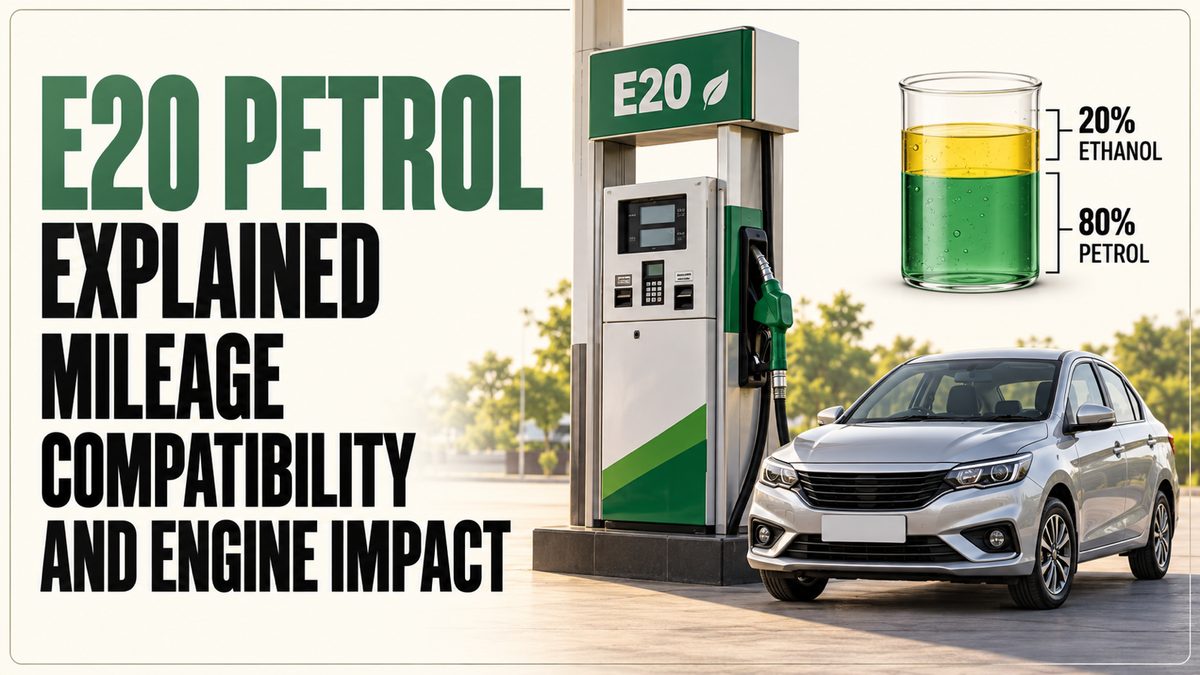
E20 petrol is a blend containing 20 per cent ethanol and 80 per cent petrol by volume. To check whether your car can use it, consult the manufacturer's current guidance for the exact model and manufacturing period. Material compatibility, engine calibration and the mileage you observe are related but different questions.
Do not assume that every older car has identical requirements or that a change in fuel economy proves engine damage. India's official ethanol programme information and manufacturer statements provide useful evidence, but your vehicle's own documentation remains important when resolving a specific concern.
What the E20 label tells you
The letter and number identify the ethanol proportion in the blend. E20 does not mean a 20 per cent mileage improvement or a 20 per cent reduction in your fuel bill. It also does not identify every other quality specification of the fuel being sold.
Ethanol blending forms part of India's petrol programme. Government material published in 2026 describes achievement of 20 per cent blending. For a driver, the practical task is to know the fuel specification permitted for the vehicle and to use an appropriate retail source, rather than treating the programme name as a vehicle-specific service instruction.
A higher ethanol blend is not automatically suitable merely because a car accepts E20. E85 and E100 belong to a different compatibility question. Never interpret an E20 statement as permission to use any ethanol concentration available.
Three questions that should not be mixed together
| Question | What it concerns | Useful evidence |
|---|---|---|
| Are the materials suitable | Parts exposed to the specified fuel | Manufacturer compatibility statement |
| Is the engine configured for the blend | Calibration and the approved operating specification | Correct model documentation |
| What mileage will I get | Fuel used over a particular journey | Careful measurement and comparable conditions |
| Is a fault present | The actual cause of a warning or poor running | Workshop diagnosis |
| Does warranty cover a complaint | Applicable terms and assessed circumstances | Written manufacturer or dealer decision |
These distinctions prevent two common mistakes. A compatible car need not deliver the same mileage under every condition. Equally, a lower tank-to-tank result does not by itself establish that a hose, seal or engine component has failed.
Check your exact car rather than a general year rule
Read the fuel section of the owner's manual and any later official manufacturer clarification. Check the manufacturing period, not only the registration year. A car first registered later may have been built earlier, while imported and locally manufactured versions can have different documentation.
Honda Cars India provides a useful example of a specific statement. It says all Honda cars manufactured in India since 1 January 2009 are E20 material compatible. Its service FAQ also addresses warranty applicability when fuel meets the stated E20 standards. That is Honda's defined scope, not a rule to copy across every brand.
If your manual and a newer brand statement appear inconsistent, ask the manufacturer to confirm the position for your vehicle identification number in writing. Keep that response. A social-media list or a dealer's casual assurance is less useful when the actual wording needs clarification.
Why the manufacturing date matters
A model name can remain on sale through several engineering updates. The same name on a boot badge does not establish that every year's components and calibration are identical. Ask for the correct version of the manual if the one supplied with a used car is missing or clearly unrelated.
Do not use an emissions-stage label as your only compatibility check. The relevant question is what the manufacturer approves for that particular petrol vehicle. A broad rule repeated online can overlook a brand that adopted suitable materials earlier or a variant requiring separate confirmation.
For a used purchase, include fuel guidance in the records review. The seller should not need to guess. Manufacturer support can help identify the correct documents, and a workshop can assess any actual complaint separately from the compatibility question.
What E20 means for mileage
Ethanol has a different energy content from petrol, but that fact alone does not translate into one fixed real-world mileage loss for every car. Vehicle design, calibration and operating conditions affect the result. Government technical material also distinguishes fuel energy content from a claimed universal percentage drop in road mileage.
Treat precise claims cautiously unless they identify the vehicle, fuel comparison, test method and conditions. A statement that one driver lost a certain percentage after a refill is an observation, not proof that every owner will see the same outcome.
Your own budget can use a cautious consumption estimate without making an engineering claim. Divide fuel price by observed km/litre to obtain cost per kilometre. That tells you what the car is costing on your use, even when several factors contribute to the result.
Measure fuel economy without creating a false comparison
Compare more than a single short journey. Keep a record of distance and fuel dispensed across several ordinary refills, using normal safe filling practice. Note major changes in traffic, route, passenger load, tyre condition and air-conditioning use.
Do not compare a relaxed highway holiday with a congested school commute and attribute the whole difference to fuel. Similarly, the dashboard estimate and a pump-based calculation may not be identical. Use a consistent method and understand its limits.
If consumption changes sharply or the car also runs poorly, arrange diagnosis. A record helps the workshop see what changed, but it should not predetermine the cause. The technician still needs to check the actual vehicle rather than accepting either fuel blame or a claim that no problem is possible.
Engine concerns need evidence from the vehicle
A warning light, difficult starting or unusual running deserves attention under the manufacturer's guidance. Do not assume E20 is the cause merely because the timing follows a refill. Nor should a general compatibility statement be used to dismiss a genuine symptom without inspection.
Record the refill receipt and the circumstances of the complaint. Share the information with an authorised workshop and request its findings. If the car's manual directs you to stop, follow that instruction rather than continuing an experiment to see whether the symptom disappears.
Keep diagnosis distinct from online predictions. A claim that every old engine will fail, or that every problem is unrelated to fuel, goes beyond what a general article can establish. The useful answer comes from model-specific approval and examination of the particular fault.
Do not assume premium petrol has a lower ethanol blend
Price and branding do not by themselves tell you the ethanol proportion. Check the retailer's actual fuel specification and the vehicle's octane requirement. Paying more for a branded product should not be treated as proof that it solves an ethanol-compatibility concern.
Ask the retailer for clear information if the pump labelling is confusing. Keep the distinction between octane and blend percentage visible. One describes a fuel characteristic different from the amount of ethanol mixed into it.
Do not mix products or add aftermarket chemicals in an attempt to create a different fuel specification. An additive advertisement is not a substitute for manufacturer approval. Ask the carmaker about permitted use before buying something presented as an easy fix.
Warranty questions should receive a written answer
Read the terms for your car and the manufacturer's latest fuel guidance. Honda's cited FAQ gives a defined E20 statement for its covered Indian-manufactured cars. Other manufacturers should be checked on their own terms rather than assumed to follow identical wording.
If a workshop says a repair is excluded because of fuel, request the diagnosis and the relevant condition in writing. If it says cover is unaffected, keep that confirmation with the service record. Clear records are more useful than a general promise repeated during a sales conversation.
Do not treat this article as a decision on a particular claim. Age, maintenance, approved fuel and the diagnosed cause can all be relevant to the assessment. Escalate an unresolved explanation through the manufacturer's customer-support process with the documents attached.
Is a conversion needed for every older car
No general instruction to replace parts across all older petrol cars is justified here. First establish what the manufacturer says about the actual vehicle. Honda's material-compatibility statement illustrates why a blanket assumption based only on age can be wrong.
If a manufacturer identifies a specific approved action, ask for its part details and procedure. Do not accept a universal kit advertised without a vehicle-specific approval basis. Fuel-system changes should be carried out only through an appropriate qualified channel.
The same caution applies to software claims. A promise that a simple tune makes every car suitable for any ethanol blend ignores material and approval questions. Confirm the permitted fuel before authorising changes that could affect operation or cover.
A useful check before your next refill
Find the correct manual, check the manufacturer's statement and resolve any uncertainty using the vehicle identification number. Save the response on your phone or with the service papers. That gives you a specific answer rather than an endlessly changing collection of online opinions.
Use normal refuelling and keep receipts when investigating a concern. Do not store or handle fuel outside approved arrangements to avoid a blend. If an actual fault appears, follow the manual and seek diagnosis promptly.
For a new car, ask the salesperson to identify the approved fuel on the handover documents. For a used car, make the same enquiry before purchase. The answer should concern that exact vehicle, not simply the current model being advertised.
Frequently asked questions
What does E20 mean
It identifies petrol blended with 20 per cent ethanol by volume. It does not promise a matching change in mileage or fuel cost.
Is every car built before 2023 unsuitable
Do not use that blanket assumption. Check the manufacturer and model. Honda, for example, states E20 material compatibility for its cars manufactured in India since 1 January 2009.
Does lower mileage prove engine damage
No. Mileage depends on several factors and needs a fair comparison. Poor running or warnings require diagnosis rather than a conclusion based only on fuel economy.
Does premium petrol guarantee less ethanol
No assumption should be made from the price or brand name. Check the fuel's stated blend and the car's approved specification.
Can an E20 car use E85 or E100
Not on the basis of E20 approval alone. Higher blends require their own manufacturer-defined compatibility and approval.
Get a model-specific answer
Check the manual and contact the manufacturer with the vehicle identity if the wording is unclear. Keep the reply and investigate real symptoms through a workshop. That is a firmer basis than either a blanket reassurance or a prediction of unavoidable damage.