



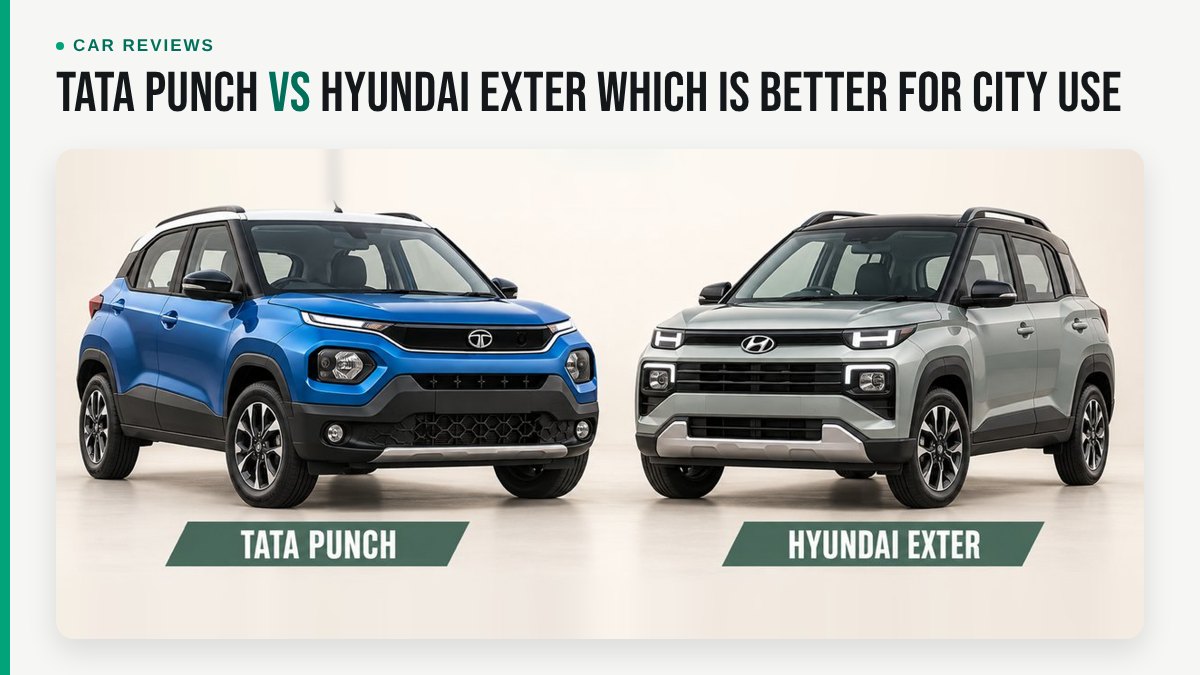
Quick answer
Consider the current Tata Punch if you want to assess a CNG AMT or turbo-petrol manual. Consider the Hyundai Exter if its 1.2-litre petrol manual, petrol AMT or CNG manual suits your commute. For a regular petrol automatic purchase, drive both AMTs on your own type of route before deciding.
Both models have changed, so older comparisons can mislead. Choose the exact engine and trim that fits your family and on-road budget. This is an editorial comparison based on manufacturer information, not an account of a first-hand road test.
What has changed in the current ranges
Tata's current Punch specification page lists petrol and iCNG with five-speed manual or AMT choices, plus a turbo-petrol six-speed manual. Hyundai's 2026 Exter announcement lists a 1.2-litre petrol with manual or AMT and a CNG manual. A claim that no Punch CNG automatic exists is therefore outdated.
The Exter update also changes equipment and luggage arrangements. Hyundai identifies a dual-cylinder CNG installation with an underbody spare tyre. Compare the car actually being ordered, not a photograph of an earlier boot or a salesperson's recollection of the old range.
Record the model year and full variant code on the quotation. Ask whether the stock offered matches the current brochure. A lower price on an earlier vehicle can be worth considering, but only after its different equipment and manufacturing details are clear.
Choose the powertrain before choosing the badge
| Daily requirement | Punch combination to check | Exter combination to check |
|---|---|---|
| Petrol with manual gears | Naturally aspirated or turbo manual | 1.2 petrol manual |
| Petrol without a clutch pedal | Petrol AMT | Petrol AMT |
| Factory CNG with manual gears | iCNG manual | Hy-CNG Duo manual |
| Factory CNG without a clutch pedal | iCNG AMT | Not in the cited 2026 launch range |
| Turbo petrol | Turbo manual | Not in the cited launch range |
The table describes range choices, not availability on every trim. Confirm the current combination before paying. A dealer promising a feature or gearbox should be able to identify the matching manufacturer specification, not simply offer an aftermarket alteration.
For buyers who have already decided on CNG automatic ownership, the Punch deserves an early inspection. For buyers who only need a petrol automatic, that extra option should not distract from comparing the two petrol AMTs fairly.
Test low speed behaviour where you actually drive
An AMT removes the clutch pedal but still uses automated gear changes. During the drive, check gentle starts, slow queues, reversing and parking. Decide whether the pauses and response suit you rather than expecting every automatic system to behave identically.
Use a route with the speed breakers, turns and traffic you normally encounter. Set the air conditioning as you would on a normal day. Carry the usual passengers where permitted, since an empty demonstration car does not represent every family journey.
Check whether you can place the car accurately beside a kerb and judge its front corners. A camera can help, but it does not replace clear visibility or comfortable controls. Do not judge the whole car only from a short open-road section near the dealership.
Petrol and CNG require different cost calculations
CNG can be worth considering when your distance and local fuel access support it. Start with your actual monthly kilometres. Include the time and distance needed to reach a reliable filling station rather than assuming the pump is always on your usual route.
Compare the extra on-road price of the CNG variant with the petrol version you would otherwise buy. Use realistic consumption assumptions in km/kg for CNG and km/l for petrol. Calculate rupees per kilometre separately; the numerical mileage figures cannot be compared as equal units.
Keep some allowance for petrol operation, scheduled maintenance and insurance. Do not promise yourself an exact payback date using only a certified efficiency figure. If your monthly driving falls, a more expensive fuel-saving option can take longer to recover its purchase premium.
CNG boot space needs an actual loading test
Tata's specification page quotes 210 litres of usable luggage space for the current Punch iCNG. Hyundai's 2026 launch document quotes 225 litres for Exter Hy-CNG Duo. These are manufacturer figures and should not be treated as a complete test of luggage practicality.
Take the bags you regularly carry. A folded pram, shopping trolley or musical instrument may fit differently from small rectangular luggage. Check how the tailgate closes, whether rear seats must be folded and how much space remains for passengers.
Ask for a demonstration of spare-tyre or repair-equipment access. Do not accept a boot inspection in which essential equipment has been removed to create more space. Secure luggage properly and avoid loading above safe visibility or restraint limits simply to make the purchase work.
Turbo performance is a separate buying decision
The Punch turbo manual adds a choice beyond the regular petrol and CNG comparison. It may interest a buyer who wants to assess stronger performance without an automatic gearbox. It does not automatically make the most sense for slow daily commuting.
Compare the price and equipment against the regular petrol manual. Check clutch operation, response at low speeds and ease of making normal progress. Test the intended version rather than assuming a naturally aspirated demonstration car describes the turbo's behaviour.
Keep the ownership calculation realistic. More performance is useful only if you value it and can afford the complete purchase. A modestly equipped car that leaves room for insurance and servicing can be a better household fit than a stretch to a higher trim.
Compare family comfort with the seats correctly set
Adjust the driver's seat for its usual occupant before trying the seat behind it. Check knee room, foot space and head clearance. Ask older passengers to try entry and exit rather than deciding for them from an external view of the car.
If three passengers will regularly use the rear seat, test all three places together. Look at seat-belt access and the space around a fitted child seat. A compact SUV shape does not guarantee generous room for every combination of adults and children.
Check storage for water bottles, school bags and phones. Try the rear windows and air-flow arrangement. These small daily tasks can matter more than an occasional-use feature that looks attractive on a showroom display.
Safety equipment and assessment records are different checks
Hyundai's 2026 Exter announcement identifies six airbags, electronic stability control and hill-start assistance as standard. That is useful equipment information. It should not be converted into an invented crash score or a promise about every possible collision.
For the Punch, use the current 2026 manufacturer brochure and applicable Bharat NCAP record, not an older car's test result. Confirm tested versions and production coverage before quoting numerical scores. Do not use the earlier Punch's equipment list to describe every current vehicle.
Inspect restraints, child-seat provisions and tyres on the exact delivered variant. Demonstrations of cameras and parking aids should include their blind spots and operating limits. Safe speed, correct belts and proper maintenance remain necessary regardless of the model you select.
Build a short equipment list before comparing trim names
Choose the items your household will use often. These may include a rear camera, convenient phone connection, adjustable seating and controls that are easy to operate. Then identify the lowest suitable trim in each range rather than immediately comparing their most expensive versions.
Try the infotainment and temperature controls while parked. Connect your own phone if the dealer permits it. Check whether common tasks require too much attention and whether the display remains readable from the normal driving position.
Do not assume matching prices mean matching equipment. Also check engine-specific omissions: a feature displayed on a petrol top trim may not be fitted to the CNG version at a similar level. Ask for the marked current feature matrix with your quote.
Compare the full quotation rather than the EMI
| Quotation item | Fair comparison method |
|---|---|
| Vehicle | Record fuel, gearbox, trim and model year |
| Registration | Use the same city and ownership category |
| Insurance | Match cover, insured value and deductibles |
| Accessories | Separate optional products from the car |
| Loan | Compare rate, fees, tenure and repayment |
| Delivery | Get the date and booking conditions in writing |
An apparently low monthly instalment can come from a larger down payment or longer repayment period. Compare the full loan arrangement. Keep a cash reserve for routine ownership instead of using every available rupee on the booking and initial payment.
Request a second quote if a charge is unclear. Do not let an accessory bundle decide the vehicle comparison without knowing its separate price and whether you actually want it.
Local service access belongs in the decision
Identify the workshop you would use for each brand. Check opening hours, travel time and the appointment process. Ask for the current maintenance schedule and warranty conditions for the chosen fuel type, especially if you are considering CNG.
Talk to the service adviser about planned maintenance rather than relying only on a sales assurance that upkeep is inexpensive. Distinguish required service items from optional treatments or cleaning packages. Obtain written prices where available and date the estimates.
Resale expectations should remain estimates. Condition, use and future demand influence the eventual offer. A claim that one badge will certainly recover a purchase premium is not a substitute for a sensible budget today.
Questions about Punch and Exter
Which has a CNG automatic option
The current Punch specification lists iCNG AMT. Hyundai's cited 2026 Exter launch range lists CNG manual. Confirm the latest orderable combination and exact trim before paying.
Are both petrol automatics AMTs
The current regular petrol automatic choices discussed here are AMTs. Drive the intended versions and assess their low-speed operation rather than assuming identical response.
Which is better for a small family
Choose after testing seating, luggage and parking with your own passengers. Fuel availability, workshop access and the complete on-road budget can change the answer between households.
Does a larger quoted boot guarantee more useful space
No. Shape, loading access and the size of your regular luggage also matter. Inspect the correct fuel version with its essential equipment in place.
Should I rely on an older comparison video
Only after confirming its model year and specification. Both ranges have changed, so old gearbox, equipment and CNG-space claims may no longer apply.
Arrange two relevant test drives
Choose petrol or CNG first, then select the gearbox you need. Test the matching Punch and Exter versions, load your regular luggage and compare written quotes. Decide from the car you will receive rather than the most impressive display vehicle.